(1895-1952)
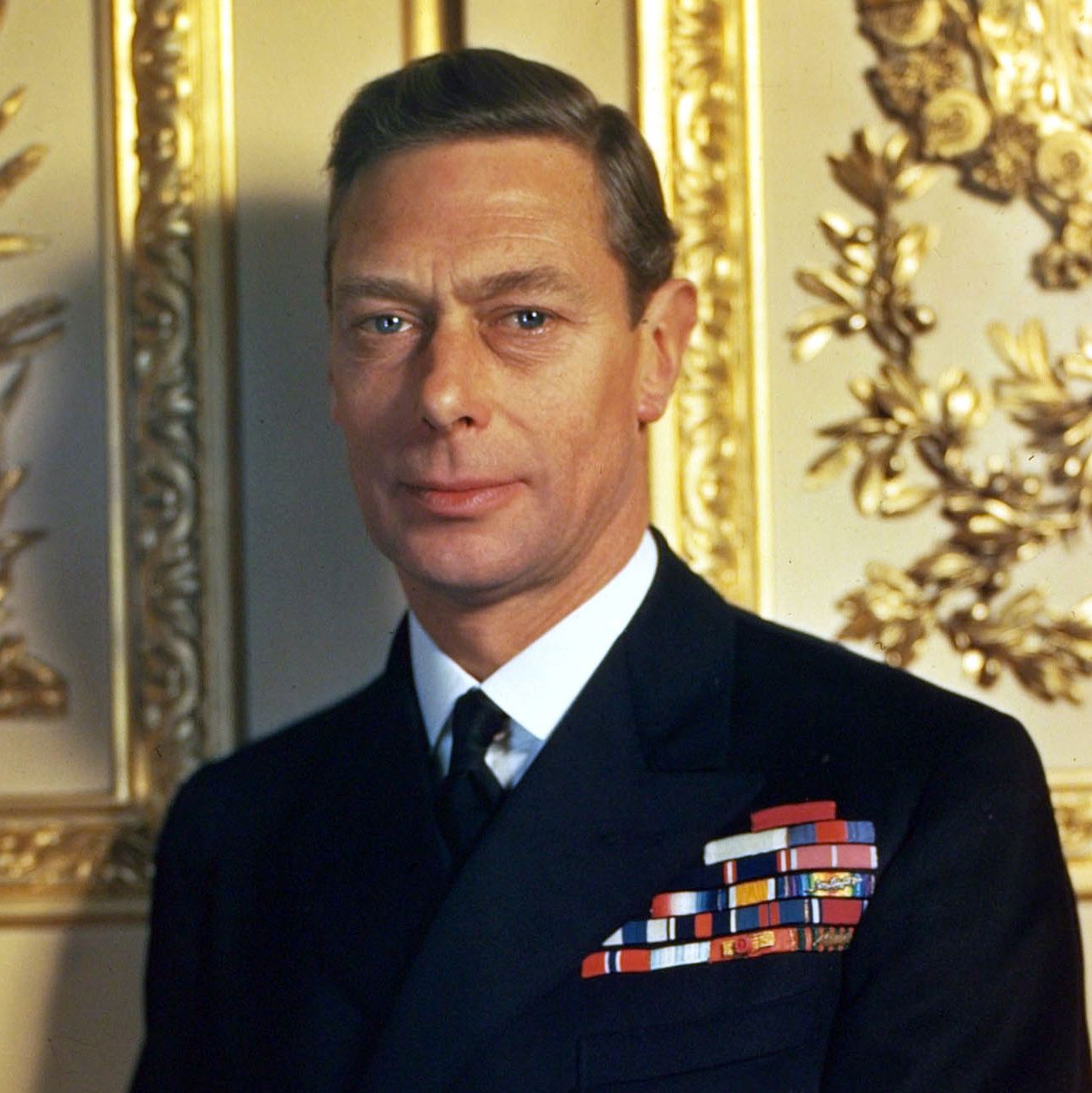
Who Was King George VI?
George VI was crowned the king of the United Kingdom in 1937 and was an important symbolic leader for the British people during World War II. He supported Winston Churchill completely throughout the war and even visited armies on the battlefronts. He was succeeded by his daughter, Queen Elizabeth II, after he died of lung cancer in 1952.
Family and Early Life
King George VI was born Albert Frederick Arthur George Saxe-Coburg-Gotha on December 14, 1895, in Norfolk, England. Though formally known as "His Highness Prince Albert of York," within the family the future king was called "Bertie," and, as a young man, "Albert."
The second son of King George V and Victoria May, the Duchess of York (Mary of Teck), Prince Albert’s youth was not easy. Though affectionate with his mother, affection was not always returned, and his father was harsh and critical. His tutors forced him to write with his right hand, though he was naturally left-handed.
At around age eight, the future King George VI developed a stammer, and he suffered the indignity of wearing leg braces to correct his knock knees. Often ill and easily frightened, Prince Albert was somewhat prone to tears and tantrums—traits that he carried throughout much of his adult life.
Military Service and Education
In 1909, Prince Albert graduated from the Royal Naval Academy at Osborne, finishing at the bottom of his class in the final exam. However, Albert progressed to the Royal Navy Academy at Dartmouth and then joined the Royal Navy as a midshipman.
During World War I, the future king served on the HMS Collingwood. He saw action at the inconclusive Battle of Juteland in May 1916. In 1919, he joined the Royal Air Force and was certified as a pilot.
After the war, Prince Albert went to Trinity College (University of Cambridge) and studied history, economics and civics. He only stayed there for one year, however, and in 1920, he was made the Duke of York and began to carry out public duties for his father.
George VI’s Wife and Kids
Around 1920 Prince Albert became reacquainted with Lady Elizabeth Bowes-Lyon, whom he had met as a child through their families' close relationship. Upon seeing her again as an attractive 18-year-old, Albert was smitten, but shy and awkward. After twice rejecting Albert's marriage proposal, Elizabeth finally accepted, and they were married on April 26, 1923, at Westminster Abbey. They had two children: Elizabeth, born in 1926, and Margaret, born in 1930.
Prince Albert and Princess Elizabeth were able to solidify their relationship during the first several years of marriage. Recognizing that his stammer was an ordeal for her husband and his audiences, Elizabeth sought the help of Lionel Logue, an Australian speech therapist living in London. At first reluctant, Prince Albert began seeing Logue and partaking in his unorthodox exercises. His wife often accompanied him and participated in the sessions. Prince Albert and Logue cultivated a strong relationship and, gradually, his speech improved.
Why Did King George Get the Throne?
King George VI’s father, King George V, had reservations about his first son, Prince Edward (Duke of Windsor), taking the throne. He once said, "I pray God that my eldest son will never marry and that nothing will come between Bertie [Prince Albert] and Lilibet [Albert’s daughter] and the throne."
On January 20, 1936, King George V died, and Edward ascended to the throne as King Edward VIII. In less than a year, he abdicated his role to Prince Albert so that he could marry his mistress, Wallis Simpson, a twice-divorced American socialite. Prince Albert was crowned on May 12, 1937, and took on the name George VI to emphasize continuity with his father and restore confidence in the monarchy.
The Start of World War II
In the 1930s, King George VI, a strong supporter of British Prime Minister Neville Chamberlain, hoped that Chamberlain would be able to stave off a war with Nazi Germany. In 1938, Chamberlain met with German Fuhrer Adolf Hitler and signed the Munich Pact.
Though Chamberlain's efforts were criticized as a "policy of appeasement" by the opposition party in Parliament, King George VI supported his prime minister. He and Chamberlain appeared together on the balcony of Buckingham Palace to greet the crowds after the agreement’s announcement, a tradition normally restricted to royal family members.
Visit To the United States
Hitler ignored the Munich Pact and continued his aggressive actions in Europe. Feeling war was a possibility, King George and Queen Elizabeth visited the United States in June 1939, forging a strong friendship with President Franklin D. Roosevelt. The royals were also well received by the American public.
The King’s Speech
In September 1939, Germany invaded Poland, violating the Munich Pact, and war was declared. With the help of his speech therapist and his wife, King George successfully made one of the most important speeches of his life, announcing to the citizens of Britain that the country was at war—an event depicted in the 2010 film The King’s Speech.
World War II
During World War II, the royal couple was resolved to stay in London at Buckingham Palace despite intense German bombing raids. King George and Queen Elizabeth undertook many morale-boosting visits to Britain’s bombed-out cities, touring hospitals and visiting with wounded troops.
In 1943 the king visited British troops in North Africa. King George VI later visited troops at Malta, bestowing on the entire island the honor of the George Cross, which he instituted to honor exceptional acts of bravery by civilians. In June 1944, 10 days after the D-Day invasion, the king visited the troops in Normandy. He suffered personal tragedy during the war when both his wife’s nephew and his youngest brother were killed.
King George VI and Winston Churchill
King George VI was not enamored with the selection of Churchill as prime minister after Chamberlain’s resignation. Nevertheless, focused on World War II, the two men quickly developed a strong working relationship and deep respect for each other.
During the victory celebration at the end of the war in Europe, the king invited Prime Minister Churchill to appear with him on the balcony of Buckingham Palace, just as he had done with Chamberlain.
King George VI’s Health and Surgery
After World War II, the stress of war began to catch up with King George VI and his health began to deteriorate rapidly. Around this time, his daughter, Princess Elizabeth, the presumptive heir, began to take on some of his royal duties. A planned tour of Australia and New Zealand was postponed after the king suffered an arterial blockage in 1949.
In 1951, following years of heavy smoking, King George was diagnosed with lung cancer and arteriosclerosis. On September 23, 1951, his left lung was removed.
Legacy
Despite his reluctance to be king, George VI was a conscientious and dedicated sovereign who assumed the throne at a time when public faith in the monarchy was at an all-time low. Armed with strong determination and the help of his wife, he became a modern monarch of the 20th century. During his reign, George VI endured the hardships of war and the transition from an empire to a commonwealth of nations and restored the popularity of the British monarchy.
King George VI’s Death
On the morning of February 6, 1952, George VI was discovered dead in bed at the age of 56. He previously suffered from lung cancer and had a lung removed; it was later determined that he had died of a coronary thrombosis.
After George VI's death, his daughter, Princess Elizabeth, took the throne, becoming Queen Elizabeth II at the age of 25. She was officially crowned at the age of 27. So as not to be confused with her daughter, King George VI’s widow, Queen Elizabeth, took on the name "Queen Mother."
"],[""],[""]]" tml-render-layout="inline">Videos
QUICK FACTS
- Name: George
- Birth Year: 1895
- Birth date: December 14, 1895
- Birth City: Norfolk, England
- Birth Country: United Kingdom
- Gender: Male
- Best Known For: George VI served as king of the United Kingdom during World War II and was an important symbolic leader. He was succeeded by Queen Elizabeth II in 1952.
- Industries
- World War II
- World Politics
- Astrological Sign: Sagittarius
- Schools
- Royal Naval Academy at Osborne
- Royal Navy Academy at Dartmouth
- Interesting Facts
- Prince Albert’s brother Edward gave up the throne so that he could marry his mistress, Wallis Simpson, a twice-divorced American socialite.
- As a child, Prince Albert was somewhat prone to tears and tantrums—traits that he carried throughout much of his adult life
- In 1909 Prince Albert graduated from the Royal Naval Academy at Osborne, finishing at the bottom of his class in the final exam
- Death Year: 1952
- Death date: February 6, 1952
- Death City: Norfolk, England
- Death Country: United Kingdom
Fact Check
We strive for accuracy and fairness.If you see something that doesn't look right,contact us!
CITATION INFORMATION
- Article Title: George VI Biography
- Author: Biography.com Editors
- Website Name: The Biography.com website
- Url: https://www.biography.com/royalty/george-vi
- Access Date:
- Publisher: A&E; Television Networks
- Last Updated: September 14, 2022
- Original Published Date: April 3, 2014
QUOTES
- I believe from my heart that the cause which binds together my peoples and our gallant and faithful Allies is the cause of Christian civilization.
- The highest of distinctions is service to others.
- Let us join in thanking Almighty God that war has ended throughout the world.