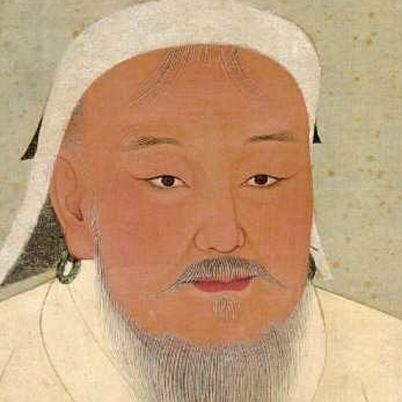
(1162-1227)
Synopsis
Genghis Khan was born "Temujin" in Mongolia around 1162. He married at age 16, but had many wives during his lifetime. At 20, he began building a large army with the intent to destroy individual tribes in Northeast Asia and unite them under his rule. He was successful; the Mongol Empire was the largest empire in the world before the British Empire, and lasted well after his own death in 1227.
Early Life
Born in north central Mongolia around 1162, Genghis Khan was originally named "Temujin" after a Tatar chieftain that his father, Yesukhei, had captured. Young Temujin was a member of the Borjigin tribe and a descendant of Khabul Khan, who briefly united Mongols against the Jin (Chin) Dynasty of northern China in the early 1100s. According to the "Secret History of the Mongols" (a contemporary account of Mongol history), Temujin was born with a blood clot in his hand, a sign in Mongol folklore that he was destined to become a leader. His mother, Hoelun, taught him the grim reality of living in turbulent Mongol tribal society and the need for alliances.
When Temujin was 9, his father took him to live with the family of his future bride, Borte. On the return trip home, Yesukhei encountered members of the rival Tatar tribe, who invited him to a conciliatory meal, where he was poisoned for past transgressions against the Tatars. Upon hearing of his father's death, Temujin returned home to claim his position as clan chief. However, the clan refused to recognize the young boy's leadership and ostracized his family of younger brothers and half-brothers to near-refugee status. The pressure on the family was great, and in a dispute over the spoils of a hunting expedition, Temujin quarreled with and killed his half-brother, Bekhter, confirming his position as head of the family.
At 16, Temujin married Borte, cementing the alliance between the Konkirat tribe and his own. Soon after, Borte was kidnapped by the rival Merkit tribe and given to a chieftain as a wife. Temujin was able to rescue her, and soon after, she gave birth to her first son, Jochi. Though Borte's captivity with the Konkirat tribe cast doubt on Jochi's birth, Temujin accepted him as his own. With Borte, Temujin had four sons and many other children with other wives, as was Mongolian custom. However, only his male children with Borte qualified for succession in the family.
The 'Universal Ruler'
When Temujin was about 20, he was captured in a raid by former family allies, the Taichi'uts, and temporarily enslaved. He escaped with the help of a sympathetic captor, and joined his brothers and several other clansmen to form a fighting unit. Temujin began his slow ascent to power by building a large army of more than 20,000 men. He set out to destroy traditional divisions among the various tribes and unite the Mongols under his rule.
Through a combination of outstanding military tactics and merciless brutality, Temujin avenged his father's murder by decimating the Tatar army, and ordered the killing of every Tatar male who was more than approximately 3 feet tall (taller than the linchpin, or axle pin, of a wagon wheel). Temujin's Mongols then defeated the Taichi'ut using a series of massive cavalry attacks, including having all of the Taichi'ut chiefs boiled alive. By 1206, Temujin had also defeated the powerful Naiman tribe, thus giving him control of central and eastern Mongolia.
The early success of the Mongol army owed much to the brilliant military tactics of Genghis Khan, as well as his understanding of his enemies' motivations. He employed an extensive spy network and was quick to adopt new technologies from his enemies. The well-trained Mongol army of 80,000 fighters coordinated their advance with a sophisticated signaling system of smoke and burning torches. Large drums sounded commands to charge, and further orders were conveyed with flag signals. Every soldier was fully equipped with a bow, arrows, a shield, a dagger and a lasso. He also carried large saddlebags for food, tools and spare clothes. The saddlebag was waterproof and could be inflated to serve as a life preserver when crossing deep and swift-moving rivers. Cavalrymen carried a small sword, javelins, body armor, a battle-ax or mace, and a lance with a hook to pull enemies off of their horses. The Mongols were devastating in their attacks. Because they could maneuver a galloping horse using only their legs, their hands were free to shoot arrows. The entire army was followed by a well-organized supply system of oxcarts carrying food for soldiers and beasts alike, as well as military equipment, shamans for spiritual and medical aid, and officials to catalog the booty.
Following the victories over the rival Mongol tribes, other tribal leaders agreed to peace and bestowed on Temujin the title of "Genghis Khan," which means "universal ruler." The title carried not only political importance, but also spiritual significance. The leading shaman declared Genghis Khan the representative of Mongke Koko Tengri (the "Eternal Blue Sky"), the supreme god of the Mongols. With this declaration of divine status, it was accepted that his destiny was to rule the world. Religious tolerance was practiced in the Mongol Empire, but to defy the Great Khan was equal to defying the will of God. It was with such religious fervor that Genghis Khan is supposed to have said to one of his enemies, "I am the flail of God. If you had not committed great sins, God would not have sent a punishment like me upon you."
Major Conquests
Genghis Khan wasted no time in capitalizing on his divine stature. While spiritual inspiration motivated his armies, the Mongols were probably driven as much by environmental circumstances. Food and resources were becoming scarce as the population grew. In 1207, he led his armies against the kingdom of Xi Xia and, after two years, forced it to surrender. In 1211, Genghis Khan's armies struck the Jin Dynasty in northern China, lured not by the great cities' artistic and scientific wonders, but rather the seemingly endless rice fields and easy pickings of wealth.
Although the campaign against the Jin Dynasty lasted nearly 20 years, Genghis Khan's armies were also active in the west against border empires and the Muslim world. Initially, Genghis Khan used diplomacy to establish trade relations with the Khwarizm Dynasty, a Turkish-dominated empire that included Turkestan, Persia, and Afghanistan. But the Mongol diplomatic mission was attacked by the governor of Otrar, who possibly believed the caravan was a cover for a spy mission. When Genghis Khan heard of this affront, he demanded the governor be extradited to him and sent a diplomat to retrieve him. Shah Muhammad, the leader of the Khwarizm Dynasty, not only refused the demand, but in defiance sent back the head of the Mongol diplomat.
This act released a fury that would sweep through central Asia and into eastern Europe. In 1219, Genghis Khan personally took control of planning and executing a three-prong attack of 200,000 Mongol soldiers against the Khwarizm Dynasty. The Mongols swept through every city's fortifications with unstoppable savagery. Those who weren't immediately slaughtered were driven in front of the Mongol army, serving as human shields when the Mongols took the next city. No living thing was spared, including small domestic animals and livestock. Skulls of men, women, and children were piled in large, pyramidal mounds. City after city was brought to its knees, and eventually the Shah Muhammad and later his son were captured and killed, bringing an end to the Khwarizm Dynasty in 1221.
Scholars describe the period after the Khwarizm campaign as the Pax Mongolica. In time, the conquests of Genghis Khan connected the major trade centers of China and Europe. The empire was governed by a legal code known as Yassa. Developed by Genghis Khan, the code was based on Mongol common law but contained edicts that prohibited blood feuds, adultery, theft and bearing false witness. Also included were laws that reflected Mongol respect for the environment such as forbidding bathing in rivers and streams and orders for any soldier following another to pick up anything that the first soldier dropped. Infraction of any of these laws was usually punishable by death. Advancement within military and government ranks was not based on traditional lines of heredity or ethnicity, but on merit. There were tax exemptions for religious and some professional leaders, as well as a degree of religious tolerance that reflected the long-held Mongol tradition of religion as a personal conviction not subject to law or interference. This tradition had practical applications as there were so many different religious groups in the empire, it would have been an extra burden to force a single religion on them.
With the annihilation of the Khwarizm Dynasty, Genghis Khan once again turned his attention east to China. The Tanguts of Xi Xia had defied his orders to contribute troops to the Khwarizm campaign and were in open revolt. In a string of victories against Tangut cities, Genghis Khan defeated enemy armies and sacked the capital of Ning Hia. Soon one Tangut official surrendered after another, and the resistance ended. Genghis Khan hadn't quite extracted all the revenge he wanted for the Tangut betrayal, however, and ordered the execution of the imperial family, thus ending the Tangut lineage.
Genghis Khan's Death
Genghis Khan died in 1227, soon after the submission of the Xi Xia. The exact cause of his death is unknown. Some historians maintain that he fell off a horse while on a hunt, and died of fatigue and injuries. Others contend that he died of respiratory disease. Genghis Khan was buried without markings, according to the customs of his tribe, somewhere near his birthplace—close to the Onon River and the Khentii Mountains in northern Mongolia. According to legend, the funeral escort killed anyone and anything they encountered to conceal the location of the burial site, and a river was diverted over Genghis Khan's grave to make it impossible to find.
Before his death, Genghis Khan bestowed supreme leadership to his son Ogedei, who controlled most of eastern Asia, including China. The rest of the empire was divided among his other sons: Chagatai took over central Asia and northern Iran; Tolui, being the youngest, received a small territory near the Mongol homeland; and Jochi (who was killed before Genghis Khan's death). Jochi and his son, Batu, took control of modern Russia and formed the Golden Horde. The empire's expansion continued and reached its peak under Ogedei Khan's leadership. Mongol armies eventually invaded Persia, the Song Dynasty in southern China, and the Balkans. Just when the Mongol armies had reached the gates of Vienna, Austria, leading commander Batu got word of the Great Khan Ogedei's death and was called back to Mongolia. Subsequently, the campaign lost momentum, marking the Mongol's farthest invasion into Europe.
Among the many descendents of Genghis Khan is Kublai Khan, who was the son of Tolui, Genghis Khan's youngest son. At a young age, Kublai had a strong interest in Chinese civilization and, throughout his life, did much to incorporate Chinese customs and culture into Mongol rule. Kublai rose to prominence in 1251, when his eldest brother, Mongke, became Khan of the Mongol Empire and placed him as governor of the southern territories. Kublai distinguished himself by increasing agricultural production and expanding Mongol territory. After Mongke's death, Kublai and his other brother, Arik Boke, fought for control of the empire. After three years of intertribal warfare, Kublai was victorious, and he was made Great Khan and emperor of the Yuan Dynasty of China.
Videos
QUICK FACTS
- Name: Genghis Khan
- Birth Year: 1162
- Birth Country: Mongolia
- Gender: Male
- Best Known For: Mongolian warrior and ruler Genghis Khan created the largest empire in the world, the Mongol Empire, by destroying individual tribes in Northeast Asia.
- Industries
- War and Militaries
- Nacionalities
- Mongolian (Mongolia)
- Death Year: 1227
- Death Country: Mongolia
Fact Check
We strive for accuracy and fairness.If you see something that doesn't look right,contact us!
CITATION INFORMATION
- Article Title: Genghis Khan Biography
- Author: Biography.com Editors
- Website Name: The Biography.com website
- Url: https://www.biography.com/political-figures/genghis-khan
- Access Date:
- Publisher: A&E; Television Networks
- Last Updated: August 30, 2019
- Original Published Date: April 3, 2014
QUOTES
- I am the flail of God. If you had not committed great sins, God would not have sent a punishment like me upon you.
- I am the punishment of God. If you had not committed great sins, God would not have sent a punishment like me upon you.
- Mother Earth is broad and her rivers and waters are numerous. Make up your camps far apart and each of you rule your own kingdom.
- I leave you the greatest empire in the world, but your preserving it depends upon your remaining always united. If discord steals in among you all will most assuredly be lost.
- Every man has his use, even if only to gather dried cow dung in the Gobi for fuel.
- How can one withdraw? Even if we die, let us challenge their boasts. Eternal Heaven, you be the judge!
- [A leader] can never be happy until his people are happy.
- The greatest joy a man can know is to conquer his enemies and drive them before him.
- If you insult the mother who gave you your life from her heart, if you cause her love for you to freeze up, even if you apologize to her later, the damage is done.
- Without the vision of a goal, a man cannot manage his own life, much less the lives of others.
- People conquered on different sides of the lake should be ruled on different sides of the lake.