(1820-1910)
Who Was Florence Nightingale?
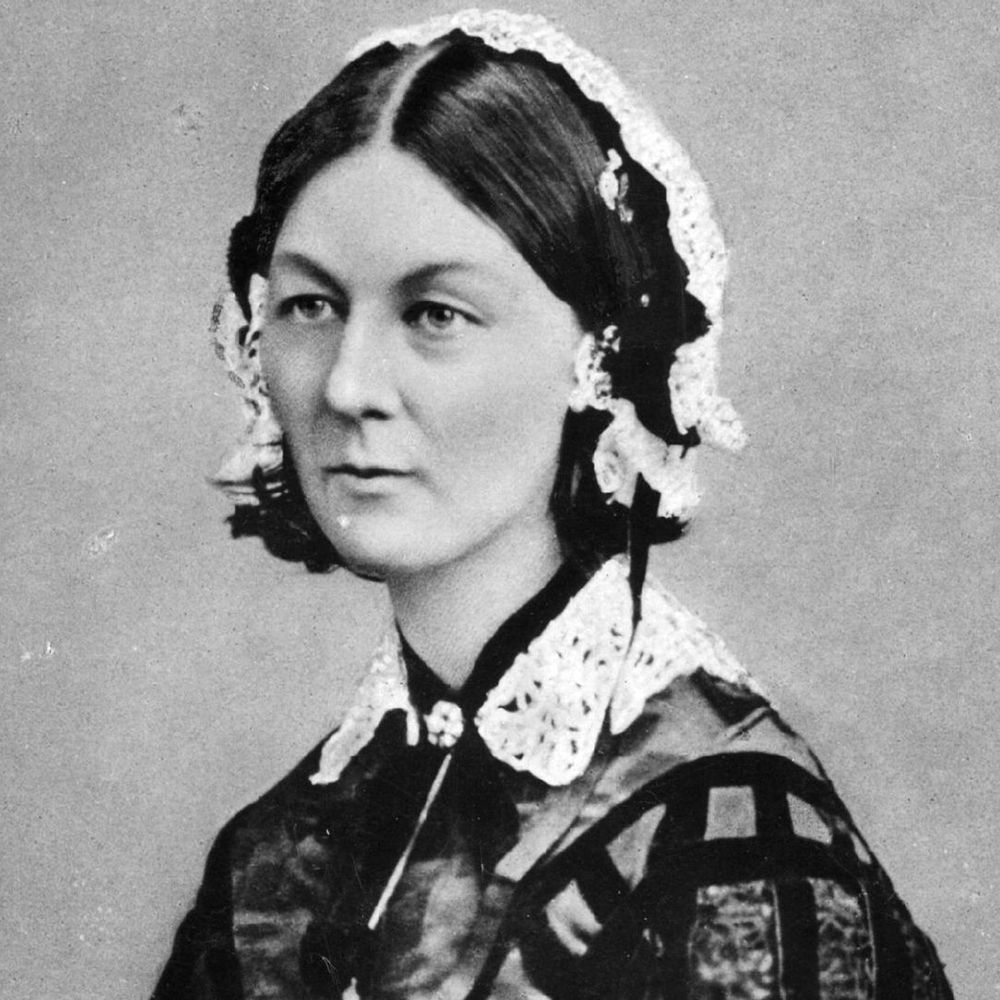
Part of a wealthy family, Florence Nightingale defied the expectations of the time and pursued what she saw as her God-given calling of nursing. During the Crimean War, she and a team of nurses improved the unsanitary conditions at a British base hospital, greatly reducing the death count. Her writings sparked worldwide health care reform, and in 1860 she established St. Thomas' Hospital and the Nightingale Training School for Nurses. A revered hero of her time, she died on August 13, 1910, in London.
Background and Early Life
Nightingale was born on May 12, 1820, in Florence, Italy, the city which inspired her name. The younger of two daughters, Nightingale was part of an affluent British clan that belonged to elite social circles. Her mother, Frances Nightingale, hailed from a family of merchants and took pride in socializing with people of prominent standing. Despite her mother's interests, Nightingale herself was reportedly awkward in social situations and preferred to avoid being the center of attention whenever possible. Strong-willed, she often butted heads with her mother, whom she viewed as overly controlling.
Nightingale's father was William Edward Nightingale (having changed his original surname, "Shore"), a wealthy landowner who would be associated with two estates—one at Lea Hurst, Derbyshire, and the other at Embly, Hampshire. Nightingale was provided with a classical education, including studies in mathematics along with German, French and Italian.
From a young age, Nightingale was active in philanthropy, ministering to the ill and poor people in the village neighboring her family’s estate. Nightingale eventually came to the conclusion that nursing was her calling; she believed the vocation to be her divine purpose.
When Nightingale approached her parents and told them about her ambitions to become a nurse, they were not pleased and forbade her to pursue appropriate training. During the Victorian Era, where English women had almost no property rights, a young lady of Nightingale's social stature was expected to marry a man of means to ensure her class standing—not take up a job that was viewed by the upper social classes as lowly menial labor.
In 1849, Nightingale refused a marriage proposal from a "suitable" gentleman, Richard Monckton Milnes, who had pursued her for years. She explained her reason for turning him down, saying that while he stimulated her intellectually and romantically, her "moral…active nature" called for something beyond a domestic life. (One biographer has suggested that the rejection of marriage to Milnes was not in fact an outright refusal.) Determined to pursue her true calling despite her parents' objections, Nightingale eventually enrolled as a nursing student in 1850 at the Institution of Protestant Deaconesses in Kaiserswerth, Germany.
Crimean War
In the early 1850s, Nightingale returned to London, where she took a nursing job in a Harley Street hospital for ailing governesses. Her performance there so impressed her employer that Nightingale was promoted to superintendent. Nightingale also volunteered at the Middlesex Hospital around this time, grappling with a cholera outbreak and unsanitary conditions conducive to the rapid spread of the disease. Nightingale made it her mission to improve hygiene practices, significantly lowering the death rate at the hospital in the process.
In October 1853, the Crimean War broke out. Allied British and French forces were at war against the Russian Empire for control of Ottoman territory. Thousands of British soldiers were sent to the Black Sea, where supplies quickly dwindled. By 1854, no fewer than 18,000 soldiers had been admitted into military hospitals.
At the time, there were no female nurses stationed at hospitals in the Crimea. After the Battle of Alma, England was in an uproar about the neglect of their ill and injured soldiers, who not only lacked sufficient medical attention due to hospitals being horribly understaffed but also languished in appallingly unsanitary conditions.
Pioneering Nurse
In late 1854, Nightingale received a letter from Secretary of War Sidney Herbert, asking her to organize a corps of nurses to tend to the sick and fallen soldiers in the Crimea. Given full control of the operation, she quickly assembled a team of almost three dozen nurses from a variety of religious orders and sailed with them to the Crimea just a few days later.
Although they had been warned of the horrid conditions there, nothing could have prepared Nightingale and her nurses for what they saw when they arrived at Scutari, the British base hospital in Constantinople. The hospital sat on top of a large cesspool, which contaminated the water and the building itself. Patients lay in their own excrement on stretchers strewn throughout the hallways. Rodents and bugs scurried past them. The most basic supplies, such as bandages and soap, grew increasingly scarce as the number of ill and wounded steadily increased. Even water needed to be rationed. More soldiers were dying from infectious diseases like typhoid and cholera than from injuries incurred in battle.
The no-nonsense Nightingale quickly set to work. She procured hundreds of scrub brushes and asked the least infirm patients to scrub the inside of the hospital from floor to ceiling. Nightingale herself spent every waking minute caring for the soldiers. In the evenings she moved through the dark hallways carrying a lamp while making her rounds, ministering to patient after patient. The soldiers, who were both moved and comforted by her endless supply of compassion, took to calling her "the Lady with the Lamp." Others simply called her "the Angel of the Crimea." Her work reduced the hospital’s death rate by two-thirds.
In addition to vastly improving the sanitary conditions of the hospital, Nightingale instituted an "invalid's kitchen" where appealing food for patients with special dietary requirements was prepared. She also established a laundry so that patients would have clean linens. as well as a classroom and library for intellectual stimulation and entertainment.
Recognition and Appreciation
Nightingale remained at Scutari for a year and a half. She left in the summer of 1856, once the Crimean conflict was resolved, and returned to her childhood home at Lea Hurst. To her surprise she was met with a hero's welcome, which the humble nurse did her best to avoid. The previous year, Queen Victoria had rewarded Nightingale's work by presenting her with an engraved brooch that came to be known as the "Nightingale Jewel" and by granting her a prize of $250,000 from the British government.
Nightingale decided to use the money to further her cause. In 1860, she funded the establishment of St. Thomas' Hospital, and within it, the Nightingale Training School for Nurses. Nightingale became a figure of public admiration. Poems, songs and plays were written and dedicated in the heroine's honor. Young women aspired to be like her. Eager to follow her example, even women from the wealthy upper classes started enrolling at the training school. Thanks to Nightingale, nursing was no longer frowned upon by the upper classes; it had, in fact, come to be viewed as an honorable vocation.
Based on her observations during the Crimea War, Nightingale wrote Notes on Matters Affecting the Health, Efficiency and Hospital Administration of the British Army, a massive report published in 1858 analyzing her experience and proposing reforms for other military hospitals. Her research would spark a total restructuring of the War Office's administrative department, including the establishment of a Royal Commission for the Health of the Army in 1857. Nightingale was also noted for her statistician skills, creating coxcomb pie charts on patient mortality in Scutari that would influence the direction of medical epidemiology.
Later Life
While at Scutari, Nightingale had contracted the bacterial infection brucellosis, also known as Crimean fever, and would never fully recover. By the time she was 38 years old, she was homebound and routinely bedridden, and would be so for the remainder of her life. Fiercely determined and dedicated as ever to improving health care and alleviating patients’ suffering, Nightingale continued her work from her bed.
Residing in Mayfair, she remained an authority and advocate of health care reform, interviewing politicians and welcoming distinguished visitors from her bed. In 1859, she published Notes on Hospitals, which focused on how to properly run civilian hospitals.
Throughout the U.S. Civil War, she was frequently consulted about how to best manage field hospitals. Nightingale also served as an authority on public sanitation issues in India for both the military and civilians, although she had never been to India herself.
In 1907, she was conferred the Order of Merit by King Edward, and received the Freedom of the City of London the following year, becoming the first woman to receive the honor. In May 1910, she received a celebratory message from King George on her 90th birthday.
Death and Legacy
In August 1910, Nightingale fell ill but seemed to recover and was reportedly in good spirits. A week later, on the evening of Friday, August 12, 1910, she developed an array of troubling symptoms. She died unexpectedly at around 2 p.m. the following day, Saturday, August 13, at her home in London.
Characteristically, she had expressed the desire that her funeral be a quiet and modest affair, despite the public's desire to honor Nightingale—who tirelessly devoted her life to preventing disease and ensuring safe and compassionate treatment for the poor and the suffering. Respecting her last wishes, her relatives turned down a national funeral. The "Lady with the Lamp" was laid to rest in her family's plot at St. Margaret's Church, East Wellow, in Hampshire, England.
The Florence Nightingale Museum, which sits at the site of the original Nightingale Training School for Nurses, houses more than 2,000 artifacts commemorating the life and career of the "Angel of the Crimea." To this day, Nightingale is broadly acknowledged and revered as the pioneer of modern nursing.
QUICK FACTS
- Name: Florence Nightingale
- Birth Year: 1820
- Birth date: May 12, 1820
- Birth City: Florence
- Birth Country: Italy
- Gender: Female
- Best Known For: Florence Nightingale was a trailblazing figure in nursing who greatly affected 19th- and 20th-century policies around proper medical care. She was known for her night rounds to aid the wounded, establishing her image as the 'Lady with the Lamp.'
- Industries
- Science and Medicine
- Astrological Sign: Taurus
- Schools
- Institution of Protestant Deaconesses at Kaiserswerth
- Nacionalities
- Italian
- Death Year: 1910
- Death date: August 13, 1910
- Death City: London
- Death Country: United Kingdom
Fact Check
We strive for accuracy and fairness.If you see something that doesn't look right,contact us!
CITATION INFORMATION
- Article Title: Florence Nightingale Biography
- Author: Biography.com Editors
- Website Name: The Biography.com website
- Url: https://www.biography.com/scientists/florence-nightingale
- Access Date:
- Publisher: A&E; Television Networks
- Last Updated: May 6, 2021
- Original Published Date: April 3, 2014
QUOTES
- All churches are, of course, only more or less unsuccessful attempts to represent the unseen to the mind.
- What the horrors of war are, no one can imagine.
- I use the word nursing for want of a better.
- Such education in women would indeed diminish the doctor's work—but no one really believes that doctors wish that there should be more illness, in order to have more work.
- It may seem a strange principle to enunciate as the very first requirement in a hospital that it should do the sick no harm.
- Hospitals are only an intermediate stage of civilization, never intended at all even to take in the whole sick population.
- I think one's feelings waste themselves in words; they ought all to be distilled into actions, and into actions which bring results.
- I attribute my success to this: I never gave or took any excuse.
- Were there none who were discontented with what they have, the world would never reach anything better.
- Nursing in an art; and if it is to be made an art, it requires as exclusive a devotion, as hard a preparation, as any painter’s or sculptor’s work.