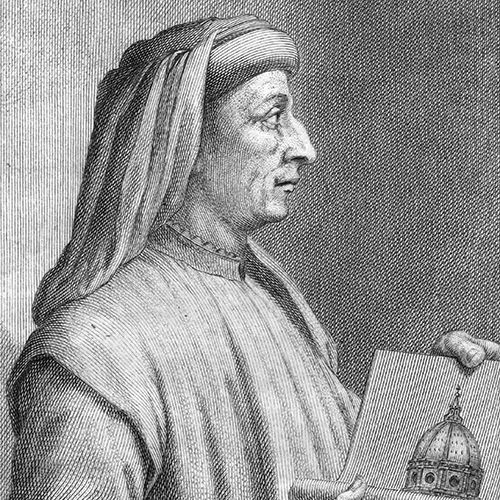
(1377-1446)
Who Was Filippo Brunelleschi?
Filippo Brunelleschi was an architect and engineer, and one of the pioneers of early Renaissance architecture in Italy. He was the first modern engineer and an innovative problem solver, building his major work, the dome of the Cathedral of Santa Maria del Fiore (the Duomo) in Florence, with the aid of machines that he invented specifically for the project.
Early Years
Born in 1377 in Florence, Italy, Brunelleschi's early life is mostly a mystery. It is known that he was the second of three sons and that his father was a distinguished notary in Florence. Brunelleschi initially trained as a goldsmith and sculptor and enrolled in the Arte della Seta, the silk merchants' guild, which also included goldsmiths, metalworkers and bronze workers. Around the turn of the century, he was designated a master goldsmith.
In 1401, Brunelleschi competed against Lorenzo Ghiberti, a young rival, and five other sculptors for the commission to make the bronze reliefs for the door of the Florence baptistery. Brunelleschi's entry, "The Sacrifice of Isaac," was the high point of his short career as a sculptor, but Ghiberti won the commission. Ghiberti went on to complete another set of bronze doors for the baptistery with the help of Renaissance giant Donatello. A hundred years later, Michelangelo said about the doors, "Surely these must be the ‘Gates of Paradise.'"
The Transition to Architecture
Brunelleschi's disappointment at losing the baptistery commission might account for his decision to concentrate his talents on architecture instead of sculpture, but little biographical information is available about his life to explain the transition. (He continued to sculpt, but architecture was the dominant thread in his professional career.) Also unexplained is Brunelleschi's sudden transition from his training in the Gothic or medieval manner to the new architectural classicism.
Perhaps he was simply inspired by his surroundings since it was in this period (1402-1404) that Brunelleschi and his good friend and sculptor Donatello purportedly visited Rome to study the ancient ruins.
Donatello, nine years Brunelleschi's junior, had also trained to be a goldsmith. After his training, he even worked in Lorenzo Ghiberti’s studio. In times past, writers and philosophers had discussed the grandeur and decline of ancient Rome, but it seems that until Brunelleschi and Donatello made their journey, no one had studied the physical presence of Rome's ruins in detail. Although Donatello remained a sculptor, the trip seems to have had a profound effect on Brunelleschi, and he turned firmly and permanently to architecture in the following decade.
The Reinvention of Linear Perspective
Early, crude ideas of perspective were known to ancient Greeks, such as Polygnotus of Thasos, as well as ancient Roman artists in their frescos, but were lost during the Middle Ages. Additionally, Arab scientist Alhazen (b. c965 - d. 1040), in his Book of Optics, described his theory about the optical basis of perspective. His book was translated into Latin during the 14th century. Early in his architectural career (c. 1410-1415), Brunelleschi "rediscovered" the principles of linear perspective. With the foundation of these principles, one can paint or draw using a single vanishing point, toward which all lines on the same plane appear to converge, and objects appear smaller as they recede into the distance.
Brunelleschi displayed his findings with two painted panels (since lost) of Florentine streets and buildings. By using Brunelleschi's perspective principles, artists of his generation were able to use two-dimensional canvases to create illusions of three-dimensional space, crafting a realism not seen previously.
Linear perspective as an artistic tool soon spread throughout the whole of Italy and then through Western Europe, and has remained a staple in artistic creation since.
Other Works and Death
Brunelleschi is also known for building or rebuilding military fortifications in such Italian cities as Pisa, Rencine, Vicopisano, Castellina and Rimini. He also created a hoist-like mechanism to help stage theatrical religious performances in Florentine churches (to assist angels in flying, for instance) and is credited with securing the first modern patent for a riverboat he invented.
Brunelleschi died in Florence on April 15, 1446, and is entombed in the Duomo. He is remembered as one of the giants of Renaissance architecture. The inscription on his grave within the basilica reads: "Both the magnificent dome of this famous church and many other devices invented by Brunelleschi the architect bear witness to his superb skill. Therefore, in tribute to his exceptional talents, a grateful country that will always remember buries him here in the soil below."
QUICK FACTS
- Name: Filippo Brunelleschi
- Birth Year: 1377
- Birth City: Florence
- Birth Country: Italy
- Gender: Male
- Best Known For: Filippo Brunelleschi was one of the leading architects and engineers of the Italian Renaissance and is best known for his work on the Cathedral of Santa Maria del Fiore (the Duomo) in Florence.
- Industries
- Architecture
- Nacionalities
- Italian
- Death Year: 1446
- Death date: April 15, 1446
- Death City: Florence
- Death Country: Italy
Fact Check
We strive for accuracy and fairness.If you see something that doesn't look right,contact us!
CITATION INFORMATION
- Article Title: Filippo Brunelleschi Biography
- Author: Biography.com Editors
- Website Name: The Biography.com website
- Url: https://www.biography.com/artists/filippo-brunelleschi
- Access Date:
- Publisher: A&E; Television Networks
- Last Updated: April 6, 2021
- Original Published Date: April 2, 2014