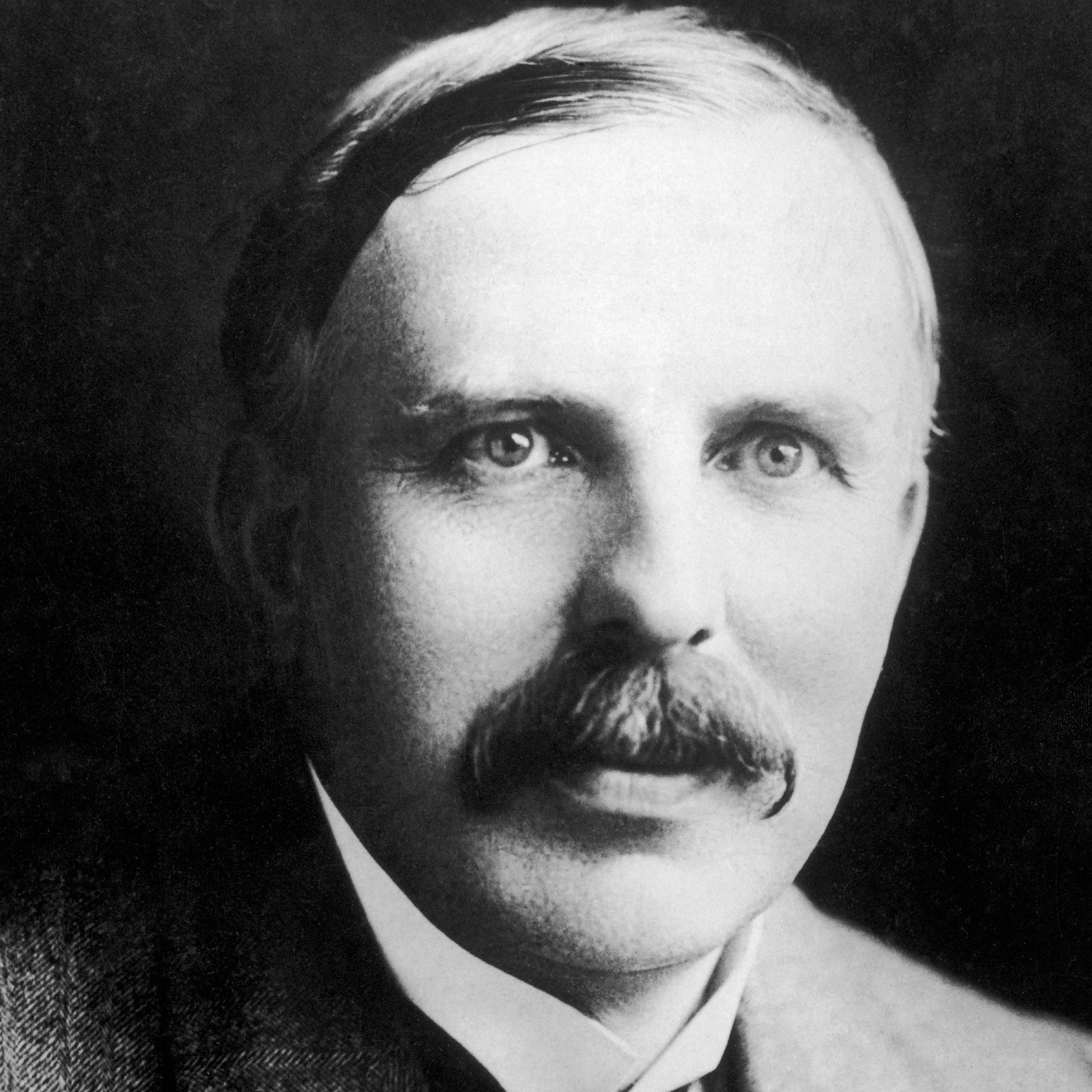
(1871-1937)
Who Was Ernest Rutherford?
A pioneer of nuclear physics and the first to split the atom, Ernest Rutherford was awarded the 1908 Nobel Prize in Chemistry for his theory of atomic structure. Dubbed the “Father of the Nuclear Age,” Rutherford died in Cambridge, England, on October 19, 1937, of a strangulated hernia.
Early Life and Education
Ernest Rutherford was born in rural Spring Grove, on the South Island of New Zealand on August 30, 1871. He was the fourth of 12 children and the second son. His father, James, had little education and struggled to support the large family on a flax millers' income. Ernest’s mother, Martha, worked as a schoolteacher. She believed that knowledge was power, and placed a strong emphasis on her children’s education.
As a child, Ernest, whose family called him “Ern,” spent most of his time after school milking cows and helping with other chores on the family farm. Weekends were spent swimming in the creek with his brothers. Since money was tight, Rutherford found inventive ways of overcoming his family’s financial challenges, including birds-nesting to earn funds for his kite-flying supplies. “We haven’t the money, so we’ve got to think,” was Rutherford’s motto at the time.
At the age of 10, Rutherford was handed his first science book, at Foxhill School. It was a pivotal moment for Rutherford, given that the book inspired his very first scientific experiment. The young Rutherford constructed a miniature cannon, which, to his family’s surprise, promptly and unexpectedly exploded. Despite the outcome, Rutherford’s interest in academics remained unfaltering. In 1887 he was awarded a scholarship to attend Nelson Collegiate School, a private secondary school where he would board and play rugby until 1889.
In 1890 Rutherford landed another scholarship—this time to Canterbury College in Christchurch, New Zealand. At Canterbury College, Rutherford’s professors fueled his enthusiasm for seeking concrete proof through scientific experimentation. Rutherford obtained both his Bachelor of Arts and his Master of Arts degrees there, and managed to achieve first-class honors in math and science. In 1894, still at Canterbury, Rutherford conducted independent research on the ability of high-frequency electrical discharge to magnetize iron. His research earned him a Bachelor of Science degree in just one year’s time. During that same year, Rutherford met and fell in love with his landlady’s daughter, Mary Newton. The couple married in 1900 and later welcomed a daughter, whom they named Eileen.
Experiments and Discoveries
In 1895, as the first research student at the University of Cambridge’s Cavendish Laboratory in London, Rutherford identified a simpler and more commercially viable means of detecting radio waves than had been previously established by German physicist Heinrich Hertz.
Also while at Cavendish Laboratory, Rutherford was invited by Professor J.J. Thomson to collaborate on a study of X-rays. German physicist Wilhelm Conrad Röntgen had discovered X-rays just months before Rutherford arrived at Cavendish, and X-rays were a hot topic among research scientists. Together, Rutherford and Thomson studied the effects of X-rays on the conductivity of gases, resulting in a paper about dividing atoms and molecules into ions. While Thomson went on to examine what would later be called an electron, Rutherford took a closer look at ion-producing radiations.
Focusing on uranium, Rutherford discovered that placing it near foil resulted in one type of radiation being easily soaked up or blocked, while a different type had no trouble penetrating the same foil. He labeled the two radiation types “alpha” and “beta.” As it turns out, the alpha particle was identical to the nucleus of a helium atom. The beta particle was, in fact, the same as an electron or positron.
Rutherford left Cambridge in 1902 and took up a professorship at McGill University in Montreal. At McGill in 1903, Rutherford and has colleague Frederick Soddy introduced their disintegration theory of radioactivity, which claimed radioactive energy was emitted from within an atom and that when alpha and beta particles were emitted at the same time, they caused a chemical change across elements. Rutherford and Yale Professor Bertram Borden Boltwood went on to categorize radioactive elements into what they called a “decay series.” Rutherford was also credited with discovering the radioactive gas radon while at McGill. Achieving fame for his contributions to the understanding of radioelements, Rutherford became an active public speaker, published numerous magazine articles and wrote the most highly regarded textbook of the time on radioactivity.
In 1907, Rutherford returned to England, transferring to a professorship at the University of Manchester. Through further experimentation involving firing alpha particles at foil, Rutherford made the groundbreaking discovery that nearly the total mass of an atom is concentrated in a nucleus. In so doing, he gave birth to the nuclear model, a discovery that marked the inception of nuclear physics and ultimately paved the way to the invention of the atom bomb. Aptly dubbed the “Father of the Nuclear Age,” Rutherford received the Nobel Prize for Chemistry in 1908.
With the advent of World War I, Rutherford turned his attention to antisubmarine research. By 1919 he had made another monumental discovery: how to artificially induce a nuclear reaction in a stable element. Nuclear reactions were Rutherford’s main focus for the rest of his scientific career.
Death and Legacy
Rutherford was awarded countless honors during his career, including several honorary degrees and fellowships from organizations such as the Institution of Electrical Engineers. In 1914 he was knighted. In 1931, he was elevated to the peerage, and granted the title Baron Rutherford of Nelson. He was also elected president of the Institute of Physics that same year.
On October 19, 1937, Baron Rutherford died in Cambridge, England at age 66 from the complications of a strangulated hernia. The scientist, who had been nicknamed “Crocodile” by his colleagues for always looking ahead, was buried at Westminster Abbey.
Years before he died, during World War I, Rutherford said he hoped scientists would not learn how to extract atomic energy until “man was living at peace with his neighbors.” The discovery of nuclear fission was, in fact, made just two years after his death, and eventually resulted in what Rutherford had feared—the use of nuclear power to build wartime weapons.
Many of Rutherford’s discoveries also became the basis of the European Organization for Nuclear Research’s construction of the Large Hadron Collider. The largest and highest-energy particle accelerator in the world and decades in the making, the Large Hadron Collider started smashing atomic particles in May 2010. It has since been used to answer fundamental questions about physics, by scientists who share in Rutherford’s tendency toward forward-thinking and his relentless quest for proof through scientific exploration.
QUICK FACTS
- Name: Ernest Rutherford
- Birth Year: 1871
- Birth date: August 30, 1871
- Birth City: Spring Grove
- Birth Country: New Zealand
- Gender: Male
- Best Known For: Physicist Ernest Rutherford was the central figure in the study of radioactivity who led the exploration of nuclear physics.
- Industries
- Science and Medicine
- Astrological Sign: Virgo
- Schools
- Canterbury College
- Nelson Collegiate School
- Nacionalities
- New Zealander
- Death Year: 1937
- Death date: October 19, 1937
- Death City: Cambridge
- Death Country: United Kingdom
Fact Check
We strive for accuracy and fairness.If you see something that doesn't look right,contact us!
CITATION INFORMATION
- Article Title: Ernest Rutherford Biography
- Author: Biography.com Editors
- Website Name: The Biography.com website
- Url: https://www.biography.com/scientists/ernest-rutherford
- Access Date:
- Publisher: A&E; Television Networks
- Last Updated: November 5, 2021
- Original Published Date: April 2, 2014