(1765-1825)
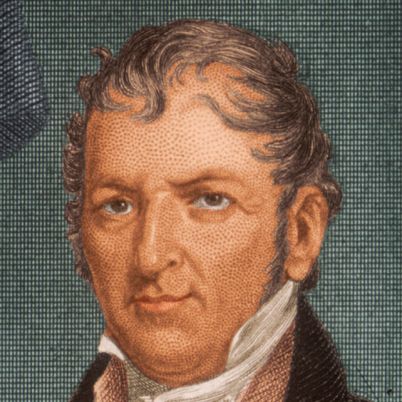
Who Was Eli Whitney?
Eli Whitney studied at Yale before going on to invent the cotton gin, a device that highly streamlined the process of extracting fiber from cotton seeds. With the patent for his device being widely pirated, Whitney struggled to earn any recompense for his invention. He later went on to pioneer “interchangeable parts” systems of production.
Early Life
Eli Whitney was born on December 8, 1765, in Westboro, Massachusetts. He grew up on a farm, yet had an affinity for machine work and technology. As a youth during the Revolutionary War, he became an expert at making nails from a device of his own invention. He later crafted canes and ladies’ hatpins, recognizing opportunity when it arose.
Creating the Cotton Gin
In 1789, Whitney started to attend Yale College and graduated in 1792, with some deliberation about becoming a lawyer. Upon graduation, Whitney was hired to be a tutor in South Carolina. On his way to his new position via boat, he met Catherine Greene, the widow of a Revolutionary War general. Once Whitney found out that his agreed-upon tutoring salary was to be halved, he refused the job and instead accepted Greene’s offer to read law at her Mulberry Grove plantation. There he met Phineas Miller, another Yale alum, who was Greene’s fiancé and manager of her estate.
Greene soon learned of the lack of a money crop in the immediate area, with the market for tobacco declining. Though green-seed cotton was widely available, it took hours of manual labor to properly clean the seed and extract the fiber. With Greene’s support, Whitney worked through the winter to devise a machine that was able to quickly and efficiently clean the cotton using a system of hooks, wires and a rotating brush.
When Whitney demonstrated his new cotton gin (“gin” being short for engine) to some colleagues—with the device producing more cotton in an hour than what could be produced by multiple workers in a day—the reaction was immediate. Local planters took to the widespread planting of green-seed cotton, immediately straining existing modes of production.
Pirated Patent and Slavery
Whitney and Miller patented the gin in 1794, with the aim of producing and installing gins throughout the South and charging farmers two-fifths of resulting profits. Their device was widely pirated, however, with farmers creating their own version of the gin. Whitney spent years in legal battles and by the turn of the century agreed to license gins at an affordable rate. Southern planters were ultimately able to reap huge financial windfalls from the invention while Whitney made almost no net profit, even after he was able to receive monetary settlements from various states.
By the mid-1800s, Southern cotton production had risen by a stratospheric amount from the previous century, with more than a million bales of cotton being produced by 1840. With people needed to harvest the crop, greed fueled an industry-stifling and dehumanizing slaveholding culture, with around a third of the U.S. Southern population enslaved by 1860.
Interchangeable Parts
During his difficulties in receiving compensation for the cotton gin, Whitney’s next big venture would involve the production of arms and champion the interchangeable-parts system. With a potential war with France on the horizon, the government looked to private contractors to supply firearms. Whitney promised to manufacture 10,000 rifles within a two-year period of time, and the government accepted his bid in 1798.
At the time, muskets were generally assembled in their entirety by individual craftsmen, with each weapon having its own distinct design. Setting up base in Connecticut, Whitney devised milling machines that would allow laborers to slice metal by a pattern and produce one particular, specific part of a weapon. When put together, each part, though made separately, became a working model.
Whitney still faced many challenges with this new system. After the first few years of production, he was able to produce only a fraction of the promised order. It took 10 years for him to complete the manufacture of 10,000 arms. Yet even with the delay, Whitney soon received another order for 15,000 muskets, which he was able to supply in two years.
There is record of other inventors having come up with the idea of interchangeable parts, and there is some skepticism on how truly interchangeable each musket piece was that came from the initial Whitney millers. Nonetheless, Whitney is credited with pushing Congress to support weapons production and helping to propagate a manufacturing system that’s influenced modern assembly lines. His pursuits have often led him to be called “the father of American technology.”
Whitney also constructed a group of worker residences that would come to be known as Whitneyville, Connecticut. He instituted a series of ethical guidelines meant to promote harmonious employee-employer relations, with roots in Puritanical beliefs. The guidelines he presented would later be ignored as industrialization took on a harsher regard for worker well-being.
Personal Life and Death
In 1817, Whitney wed Henrietta Edwards. The couple would have several children, with Eli Whitney Jr. continuing to work in his father’s manufacturing business as an adult. The elder Whitney died on January 8, 1825, in New Haven, Connecticut.
Related Videos
QUICK FACTS
- Name: Whitney
- Birth Year: 1765
- Birth date: December 8, 1765
- Birth State: Massachusetts
- Birth City: Westboro
- Birth Country: United States
- Gender: Male
- Best Known For: Eli Whitney was an American inventor who created the cotton gin and pushed the “interchangeable parts” mode of production.
- Industries
- Business and Industry
- Technology and Engineering
- Astrological Sign: Sagittarius
- Schools
- Yale University
- Death Year: 1825
- Death date: January 8, 1825
- Death State: Connecticut
- Death City: New Haven
- Death Country: United States
Fact Check
We strive for accuracy and fairness.If you see something that doesn't look right,contact us!
CITATION INFORMATION
- Article Title: Eli Whitney Biography
- Author: Biography.com Editors
- Website Name: The Biography.com website
- Url: https://www.biography.com/inventors/eli-whitney
- Access Date:
- Publisher: A&E; Television Networks
- Last Updated: June 23, 2020
- Original Published Date: April 2, 2014