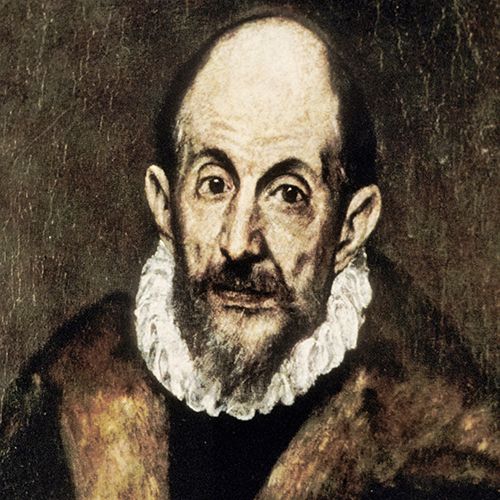
(1541-1614)
Who Was El Greco?
El Greco was born around 1541 in Crete, which was then part of the Republic of Venice. In his mid-twenties, he traveled to Venice and studied under Titian, who was the most renowned painter of his day. Around age 35, he moved to Toledo, Spain, where he lived and worked for the rest of his life, producing his best-known paintings. His works from this period are seen as precursors of both Expressionism and Cubism. He is remembered chiefly for his elongated, tortured figures, often religious in nature, the style of which baffled his contemporaries but helped establish his reputation in the years to come.
Early Years: Venice and Rome
El Greco was born Domenikos Theotokopoulos on the island of Crete, which was at the time a Venetian possession. Around age 20, somewhere between 1560 and 1565, El Greco (which means “The Greek”) went to Venice to study and found himself under the tutelage of Titian, the greatest painter of the time. Under Titian, El Greco began mastering the fundamental aspects of Renaissance painting—e.g., perspective, constructing figures and staging detailed narrative scenes (a prime example of his work from this period is The Miracle of Christ Healing the Blind).
El Greco moved to Rome from Venice after a time, remaining from 1570 to 1576, staying initially in the palace of Cardinal Alessandro Farnese, one of the most influential and wealthy individuals in Rome. In 1572, El Greco joined the painters’ academy and established a studio, but success would prove elusive (El Greco had criticized Michelangelo’s artistic abilities, which likely led to him being ostracized by the Roman art establishment), and he left Rome for Spain in 1576.
Finding a Foothold: Toledo, Spain
In Madrid, El Greco tried to secure royal patronage from King Philip II, but to no avail, so he moved on to Toledo, where he finally began to find the success history would remember and where he would paint his masterpieces.
In Toledo, El Greco met Diego de Castilla, the dean of the Toledo Cathedral, who commissioned El Greco to paint a group of works for the altar of the church of Santo Domingo el Antiguo (such as The Trinity and The Assumption of the Virgin, both 1579). Castilla also facilitated the commission of The Disrobing of Christ (1579), and these paintings would become some of El Greco’s most accomplished masterworks. Unfortunately, the price El Greco demanded for The Disrobing of Christ led to a dispute, and he never received another comparable commission from Castilla again.
Regardless of where commissions now came from, El Greco embarked on a wildly successful career in Toledo and produced such landmark works as St. Sebastian (1578), St. Peter in Tears (1582) and The Burial of Count Orgaz (1588). The Burial of Count Orgaz, especially, encapsulates El Greco’s art in that it depicts a visionary experience, transcending the known and revealing that which exists in the spiritual imagination. One of El Greco’s most celebrated works, it features a dichotomy of heaven and earth, the burial and the spiritual world waiting above and it took his artistic vision beyond what he had previously been able to accomplish.
Another notable work from this period is View of Toledo (1597), which is considered the first landscape in Spanish art. It is also is one of the only, if not the only, surviving landscapes done by El Greco, who rarely strayed from religious subjects and portraits.
Later Years and Legacy
El Greco’s later works are marked by exaggerated, and often distorted, figures, stretching beyond the realities of the human body (which is what modern viewers generally have found so appealing). Among them are The Adoration of the Shepherds (1599), Concert of Angels (1610) and The Opening of the Fifth Seal (1614). Fifth Seal, in particular, went on to spark great debate, as it has been suggested that it was an influence on Pablo Picasso’s Les Demoiselles d'Avignon, often considered the first cubist painting.
El Greco’s effect on Picasso’s evolution is just one thread of his influence. The twisting figures and brash, unreal colors that form the very foundation of El Greco’s art influenced scores of artists, from the cubists following Picasso to the German expressionists to the abstract impressionists after them. His work also inspired those outside the realm of painting, such as writers Rainer Maria Rilke and Nikos Kazantzakis. El Greco died on April 7, 1614, unappreciated in his time, with the art world waiting 250 years before embracing his status as a master.
QUICK FACTS
- Birth Year: 1541
- Birth City: Candia, Crete
- Birth Country: Greece
- Gender: Male
- Best Known For: El Greco was a Greek artist whose painting and sculpture helped define the Spanish Renaissance and influence various movements to come.
- Industries
- Architecture
- Art
- Nacionalities
- Greek
- Italian
- Spanish
- Death Year: 1614
- Death date: April 7, 1614
- Death City: Toledo
- Death Country: Spain
Fact Check
We strive for accuracy and fairness.If you see something that doesn't look right,contact us!
CITATION INFORMATION
- Article Title: El Greco Biography
- Author: Biography.com Editors
- Website Name: The Biography.com website
- Url: https://www.biography.com/artists/el-greco
- Access Date:
- Publisher: A&E; Television Networks
- Last Updated: April 6, 2021
- Original Published Date: April 2, 2014