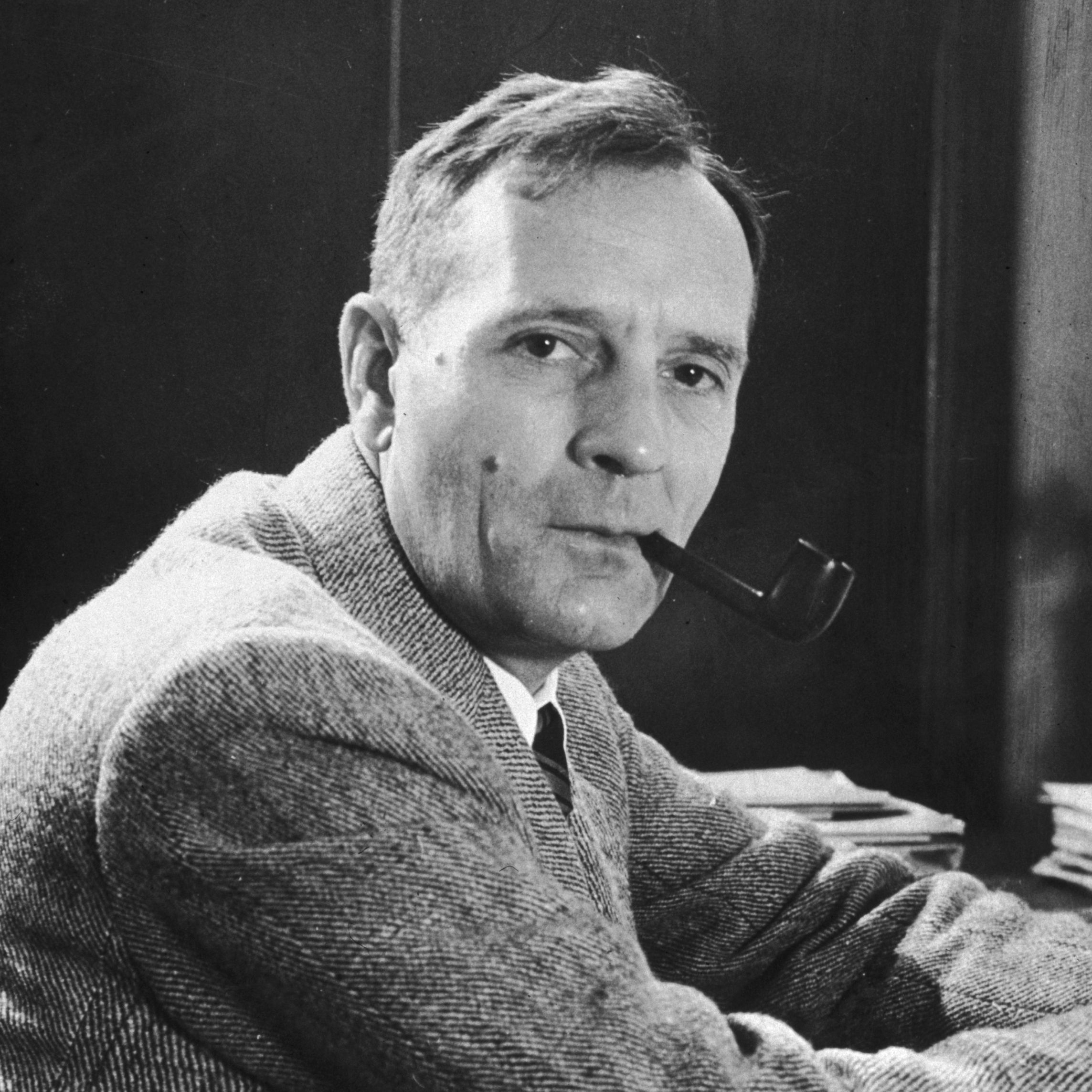
(1889-1953)
Who Was Edwin Hubble?
Edwin Hubble graduated from the University of Chicago and served in WWI before settling down to lead research in the field of astrophysics at Mount Wilson Observatory in California. Hubble's revolutionary work includes finding a constant relationship between galaxies' redshift and distance, which helped to eventually prove that the universe is expanding. Additionally, a classification system that he created for galaxies has been used by other researchers for decades, now known as the Hubble sequence.
Early Life
Born in Marshfield, Missouri on November 20, 1889, to father John Powell Hubble and mother Virginia Lee (James) Hubble, Edwin Hubble began reading science-fiction novels at a young age. One of his favorite books was Jules Verne's 20,000 Leagues Under the Sea.
In 1898, when he was 10 years old, Hubble and his seven siblings moved with their parents to Chicago, Illinois. There, Hubble attended high school and excelled at sports, particularly track and field—as a high school student, he broke the Illinois state high jump record.
Hubble received a scholarship to attend the University of Chicago in 1906. While there, he worked as a lab assistant under Robert Millikan, who later won a Nobel Prize for his work in the field of physics. After graduating in 1910, Hubble left Chicago and enrolled at the University of Oxford, where he studied law philosophy. He graduated from the school three years later, obtaining a bachelor's degree in jurisprudence. Around the same time, Hubble's father, John Hubble, died.
Acclaimed Career
After a short stint teaching in Indiana, Hubble returned to the University of Chicago to study astronomy. Not long after, he was recruited by California's Mount Wilson Observatory to help complete the construction of its Hooker telescope. Before beginning the new position — which he excitedly accepted — Hubble completed a doctorate in astronomy, enlisted in the U.S. Army and served a tour of duty in World War I.
While working at Mount Wilson, Hubble proved that other galaxies existed outside of the Milky Way, where Earth is located, by taking photos through the observatory's Hooker telescope and comparing the varying degrees of luminosity among Cepheid variable stars. There had been no clear idea of the Milky Way's size at the time, and through his research, Hubble was able to estimate that the Andromeda Nebula (thought of simply as a spiral at the time) was nearly 900,000 light years away from the Milky Way, thus it had to be its own galaxy. The Andromeda Nebula was later proven to be much farther away, at nearly 2.48 million light years (through further analyses of the spacial indications of stars' light). The Andromeda Nebula was later renamed the Andromeda Galaxy.
In the early mid-1920s, Hubble began conducting new research, along with fellow astronomer Milton Humason, on the galaxies' spectral shifts and unique distances, particularly looking at their relationship with the earth. He and Humason then published their research in 1929, theorizing that redshifts in galaxies' light emissions—which shows that galaxies are moving away from each other—move at a linear rate to the distance between them. In other words, Hubble was stating that a galaxy's redshift is twice the size as another's when it's twice as far from another galaxy. The two men's research was widely well-received.
In 1936, Hubble published The Realm of the Nebulae, a historical and explanatory piece on his research in the field of extragalactic astronomy. Hubble worked at Mount Wilson Observatory until 1942, when he left to work at the Aberdeen Proving Grounds in Maryland during World War II. For his service during the war, in 1946, Hubble received the Medal of Merit.
Death and Legacy
Hubble continued to conduct research at the Mount Wilson Observatory, as well as the Palomar Observatory in California, until he died on September 28, 1953. He had suffered a stroke that was caused by cerebral thrombosis, and was 63 years old at the time.
Hubble's work in the field of astronomy was truly revolutionary. By showing that other galaxies existed, scientists had a better idea of the concept of the size of the universe and the possibility of other planets. The classification system for galaxies that he created (now known as the Hubble sequence) has been used by other researchers for nearly a century.
Hubble's work with Humason helped bolster the then-theory that the universe was expanding—a connection that Hubble ardently denied could be made with any certainty, and published his sentiments with the help of chemist Richard Tolman in the mid-1930s. Since then, however, the expanding-universe theory has largely been accepted by scientists worldwide. Hubble's and Humason's research work also helped prove that galaxies must come from a central point of origin, and was used by some scientists to support the Big Bang Theory—one of the most popular theories on the universe's origin, which was first suggested by Georges Lemaître in 1927.
Hubble remains one of the world's most famous astronomers. In addition to receiving the Medal of Merit (1946), he is the recipient of the Franklin Medal (in physics), Legion of Merit, Bruce Medal and Gold Medal (from the Royal Astronomical Society). As a tribute to Hubble's groundbreaking work in astrophysics, NASA named its Hubble Space Telescope after Edwin Hubble. Countless university facilities, a planetarium, an asteroid and a portion of a highway in Missouri also share his name.
Personal Life
Hubble married Grace Burke on February 26, 1924. The couple never had children.
QUICK FACTS
- Name: Edwin Powell Hubble
- Birth Year: 1889
- Birth date: November 20, 1889
- Birth State: Missouri
- Birth City: Marshfield
- Birth Country: United States
- Gender: Male
- Best Known For: Astronomer Edwin Hubble revolutionized the field of astrophysics. His research helped prove that the universe is expanding, and he created a classification system for galaxies that has been used for several decades.
- Industries
- Journalism and Nonfiction
- World War I
- Education and Academia
- Science and Medicine
- Space Exploration
- Astrological Sign: Scorpio
- Schools
- Oxford University
- University of Chicago
- Death Year: 1953
- Death date: September 28, 1953
- Death State: California
- Death City: San Marino
- Death Country: United States
Fact Check
We strive for accuracy and fairness.If you see something that doesn't look right,contact us!
CITATION INFORMATION
- Article Title: Edwin Hubble Biography
- Author: Biography.com Editors
- Website Name: The Biography.com website
- Url: https://www.biography.com/scientists/edwin-hubble
- Access Date:
- Publisher: A&E; Television Networks
- Last Updated: May 20, 2021
- Original Published Date: April 2, 2014