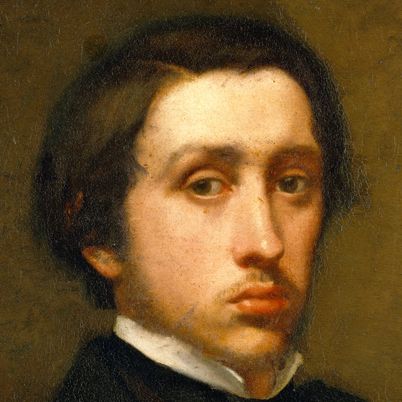
(1834-1917)
Who Was Edgar Degas?
Edgar Degas studied at the École des Beaux-Arts in Paris and became renowned as a stellar portraitist, fusing Impressionistic sensibilities with traditional approaches. Both a painter and sculptor, Degas enjoyed capturing female dancers and played with unusual angles and ideas around centering. His work influenced several major modern artists, including Pablo Picasso.
Early Life
Degas was born Hilaire-Germain-Edgar de Gas on July 19, 1834, in Paris, France. (As an adult, Degas reverted his last name back to the original spelling.) His father, Auguste, was a banker, and his mother, Celestine, was an American from New Orleans. Their family were members of the middle class with nobler pretensions. For many years, the Degas family spelled their name "de Gas"; the preposition "de" suggesting a land-owning aristocratic background which they did not actually have.
Degas came from a very musical household – his mother was an amateur opera singer and his father occasionally arranged for musicians to give recitals in their home. Degas attended the Lycée Louis-le-Grand, a prestigious and rigorous boys' secondary school, where he received a classical education.
Degas also displayed a remarkable skill for drawing and painting as a child, a talent encouraged by his father, who was a knowledgeable art lover. In 1853, at the age of 18, he received permission to "copy" at the Louvre in Paris. (During the 19th century, aspiring artists developed their technique by attempting to replicate the works of the masters.) He produced several impressive copies of Raphael as well, studying the work of more contemporary painters such as Ingres and Delacroix.
In 1855, Degas gained admission into the École des Beaux-Arts (formerly the Académie des Beaux-Arts) in Paris. However, after only one year of study, Degas left school to spend three years traveling, painting and studying in Italy. He painted painstaking copies of the works of the great Italian renaissance painters Michelangelo and da Vinci, developing a reverence for classical linearity that remained a distinguishing feature of even his most modern paintings.
Early Works
Upon returning to Paris in 1859, Degas set out to make a name for himself as a painter. Taking a traditional approach, he painted large portraits of family members and grand historical scenes such as "The Daughter of Jephtha," "Semiramis Building Babylon" and "Scene of War in the Middle Ages." Degas submitted these works to the all-powerful Salon, a group of French artists and teachers who presided over public exhibitions. It had very rigid and conventional ideas of beauty and proper artistic form and received Degas's paintings with measured indifference.
In 1862, Degas met fellow painter Edouard Manet at the Louvre, and the pair quickly developed a friendly rivalry. Degas grew to share Manet's disdain for the presiding art establishment as well as his belief that artists needed to turn to more modern techniques and subject matter.
By 1868, Degas had become a prominent member of a group of avant-garde artists including Manet, Pierre-Auguste Renoir, Claude Monet and Alfred Sisley, who gathered frequently at the Café Guerbois to discuss ways in which artists could engage the modern world. Their meetings coincided with tumultuous times in the history of France. In July 1870, the Franco-Prussian War broke out and the highly nationalistic Degas volunteered for the French National Guard. At the war's conclusion in 1871, the infamous Paris Commune seized control of the capital for two terrifying months before Adolphe Thiers reestablished the Third Republic in a bloody civil war. Degas largely avoided the tumult of the Paris Commune by taking an extended trip to visit relatives in New Orleans.
Emergence of Impressionists
Returning to Paris near the end of 1873, Degas, along with Monet, Sisley and several other painters, formed the Société Anonyme des Artistes (Society of Independent Artists), a group committed to putting on exhibitions free of the Salon's control. The group of painters would come to be known as the Impressionists (though Degas preferred the term "realist" to describe his own work), and on April 15, 1874, they held the first Impressionist exhibition. The paintings Degas exhibited were modern portraits of modern women — milliners, laundresses and ballet dancers — painted from radical perspectives.
Over the course of the next 12 years, the group staged eight such Impressionist exhibitions, and Degas exhibited at all of them. His most famous paintings during these years were "The Dancing Class" (1871), "The Dance Class" (1874), "Woman Ironing" (1873) and "Dancers Practicing at the Bar" (1877). In 1880, he also sculpted "The Little Fourteen-Year-Old Dancer," a sculpture so hauntingly evocative that while some critics called it brilliant, others condemned him as cruel for having made it. While Degas's paintings are not overtly political, they do reflect France's changing social and economic environment. His paintings portray the growth of the bourgeoisie, the emergence of a service economy and the widespread entrance of women into the workplace.
In 1886, at the eighth and final Impressionist exhibition in Paris, Degas exhibited 10 paintings of nude women in various stages of bathing. These nude paintings were the talk of the exhibition and also the source of controversy; some called the women "ugly" while others praised the honesty of his depictions. Degas went on to paint hundreds of studies of nude women. He also continued to paint dancers, contrasting the awkward humility of the dancer backstage with her majestic grace in the midst of performance.
In the mid-1890s, an episode known as the "Dreyfus Affair" sharply divided French society. In 1894, Alfred Dreyfus, a young Jewish captain in the French military, was convicted of treason on spying charges. Although evidence that proved Dreyfus's innocence surfaced in 1896, rampant anti-Semitism kept him from being exonerated for another 10 years. With the country deeply divided between those in support of Dreyfus and those against him, Degas sided with those whose anti-Semitism blinded them to Dreyfus's innocence. His stance against Dreyfus cost him many friends and much respect within the typically more tolerant avant-garde art circles.
Later Years, Death and Legacy
Degas lived well into the 20th century, and though he painted less during these years, he promoted his work tirelessly and became an avid art collector. He never married, though he did count several women, including American painter Mary Cassatt, among his intimate friends. Degas died in Paris on September 27, 1917, at the age of 83.
While Degas has always been recognized as one of the greatest Impressionist painters, his legacy has been mixed in the decades since his death. The misogynist overtones present in his sexualized portraits of women, as well as his intense anti-Semitism, have served to alienate Degas from some modern critics. Still, the sheer beauty of his early works and the distinctly modern self-conscious elusiveness of his later portraits ensure Degas a lasting legacy. One thing remains indisputable about Degas: His were among the most painstakingly polished and refined paintings in history. An obsessive and careful planner, Degas liked to joke that he was the least spontaneous artist alive. "If painting weren't difficult," he once remarked, "it wouldn't be so fun."
QUICK FACTS
- Name: Edgar Degas
- Birth Year: 1834
- Birth date: July 19, 1834
- Birth City: Paris
- Birth Country: France
- Gender: Male
- Best Known For: Painter and sculptor Edgar Degas was a highly celebrated 19th-century French Impressionist whose work helped shape the fine art landscape for years to come.
- Industries
- Painting
- Sculpture
- Astrological Sign: Cancer
- Schools
- École des Beaux-Arts (formerly the Académie des Beaux-Arts, Paris)
- University of Paris (Université de Paris)
- Lycée Louis-le-Grand
- Nacionalities
- French
- Death Year: 1917
- Death date: September 27, 1917
- Death City: Paris
- Death Country: France
Fact Check
We strive for accuracy and fairness.If you see something that doesn't look right,contact us!
CITATION INFORMATION
- Article Title: Edgar Degas Biography
- Author: Biography.com Editors
- Website Name: The Biography.com website
- Url: https://www.biography.com/artists/edgar-degas
- Access Date:
- Publisher: A&E; Television Networks
- Last Updated: August 6, 2020
QUOTES
- If painting weren't difficult, it wouldn't be so fun.