(1940-2021)
Who Was Chuck Close?
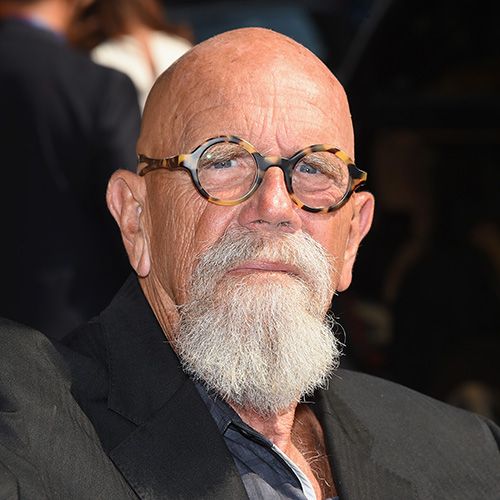
Suffering from severe dyslexia, Chuck Close did poorly in school but found solace in making art. After earning his MFA from Yale in 1964, Close took his place atop the American art world by creating large-scale, photorealist portraits that creatively blurred the distinction between photography and painting. Toward the end of his career, Close faced charges of sexual harassment, for which he apologized. He died August 19, 2021 in Oceanside, New York at age 81.
Early Life
Charles Thomas Close was born July 5, 1940, in Monroe, Washington. The son of artistic parents who showed great support of their boy's early creative interests, Close, who suffered from severe dyslexia, struggled in almost all phases of schoolwork except art. He was not terribly popular in school, and his problems were furthered by a neuromuscular condition that prevented him from playing sports.
For the first decade of his life, Close's childhood was more or less stable. But when he was 11, tragedy struck, when his father died and his mother fell ill with breast cancer. Close's own health took a terrible turn around this time when a kidney infection landed him in bed for almost a year.
Through all of this, however, Close deepened his love for painting and art in general. At the age of 14, he saw an exhibition of Jackson Pollock paintings. Pollock's style and flair had a great impact on Close, and, as he later recounted, it made him determined to become an artist.
Education and Early Work
Close eventually enrolled at the University of Washington. After graduating in 1962 he immediately headed east to Yale to study for a Master of Fine Arts from the university's Art and Architecture School.
Steeped in the abstract world, Close radically changed his focus at Yale, opting for what would become his signature style: photorealism. Using a process he came to describe as "knitting," Close created large-format Polaroids of models that he then re-created on large canvases.
This early work was bold, intimate and up-front, replicating particular details of his selected faces. His ability to zero-in on such details was particularly striking given the fact that Close suffered from the neurological condition prosopagnosia, or face-blindness, which prevented him from recognizing faces. His work was pioneering in the way it blurred the distinction between painting and photography. His techniques were also noteworthy, in particular his application of color, which he claimed help pave the way for the development of the inkjet printer.
By the late 1960s, Close and his photorealist pieces were entrenched in the New York City art scene. One of his best-known subjects from that period was of another young artistic talent, composer Philip Glass, whose portrait Close painted and showed in 1969. It has since gone on to become one of his most recognized pieces. He later painted choreographer Merce Cunningham and former President Bill Clinton, among others.
By the 1970s, Close's work was shown in the world's finest galleries, and he was widely considered one of America's best contemporary artists.
Paralysis and Perseverance
In 1988, Close again experienced a severe health issue when he suffered the sudden rupture of a spinal artery. In the immediate aftermath of the rupture, Close was almost entirely paralyzed. Eventually, after rounds of physical therapy, Close, who became permanently confined to a wheelchair, regained the partial use of his limbs.
Despite the physical limitations, Close pressed forward with his work. With a brush taped to his wrist, Close continued to paint, but in a style that was more abstract and less precise.
In his later years, Close's work was met with rave reviews and expensive commissions. In 2000 President Clinton named Close a recipient of the National Medal of Arts. In 2007 his life became the subject of a full-length documentary, Chuck Close: A Portrait in Progress, directed by Marion Cajori.
Personal Life
Close divorced his first wife, Leslie, in 2011. Two years later, he married artist Sienna Shields.
In late 2017, the Close found himself grouped among the expanding list of influential men accused of sexual misconduct. The accusations generally involved the artist asking women to pose naked for him, and making crude comments about their body parts.
"Last time I looked, discomfort was not a major offense," he said, in defense of his actions. "I never reduced anyone to tears, no one ever ran out of the place. If I embarrassed anyone or made them feel uncomfortable, I am truly sorry, I didn’t mean to. I acknowledge having a dirty mouth, but we’re all adults."
QUICK FACTS
- Name: Chuck Thomas Close
- Birth Year: 1940
- Birth date: July 5, 1940
- Birth State: Washington
- Birth City: Monroe
- Birth Country: United States
- Gender: Male
- Best Known For: Chuck Close was noted for his highly inventive techniques used to paint the human face. He rose to fame in the late 1960s for his large-scale, photo-realist portraits.
- Industries
- Art
- Education and Academia
- Astrological Sign: Cancer
- Schools
- Yale University School of Art and Architecture
- University of Washington School of Art
- Interesting Facts
- Chuck Close suffered from the neurological disorder prosopagnosia, or face-blindness, which impairs his ability to recognize faces.
- Death Year: 2021
- Death State: New York
- Death City: Oceanside
Fact Check
We strive for accuracy and fairness.If you see something that doesn't look right,contact us!
CITATION INFORMATION
- Article Title: Chuck Close Biography
- Author: Biography.com Editors
- Website Name: The Biography.com website
- Url: https://www.biography.com/artists/chuck-close
- Access Date:
- Publisher: A&E; Television Networks
- Last Updated: August 20, 2021
- Original Published Date: April 2, 2014
QUOTES
- I think most paintings are a record of the decisions that the artist made. I just perhaps make them a little clearer than some people have.