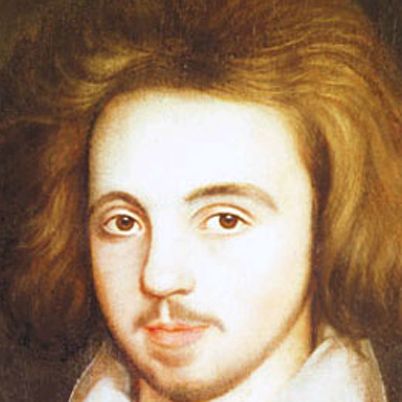
(1564-1593)
Who Was Christopher Marlowe?
While Christopher Marlowe's literary career lasted less than six years, and his life only 29 years, his achievements, most notably the play The Tragicall History of Doctor Faustus, ensured his lasting legacy.
Early Years
Christopher Marlowe was born in Canterbury around February 26, 1564 (this was the day on which he was baptized). He went to King's School and was awarded a scholarship that enabled him to study at Corpus Christi College, Cambridge, from late 1580 until 1587.
Marlowe earned his bachelor of arts degree in 1584, but in 1587 the university hesitated in granting him his master's degree. Its doubts (perhaps arising from his frequent absences, or speculation that he had converted to Roman Catholicism and would soon attend college elsewhere) were set to rest, or at least dismissed, when the Privy Council sent a letter declaring that he was now working "on matters touching the benefit of his country," and he was awarded his master's degree on schedule.
Marlowe as a Secret Agent?
The nature of Marlowe's service to England was not specified by the council, but the letter sent to Cambridge has provoked abundant speculation, notably the theory that Marlowe had become a secret agent working for Sir Francis Walsingham's intelligence service. No direct evidence supports this theory, but the council's letter clearly suggests that Marlowe was serving the government in some secret capacity.
Surviving Cambridge records from the period show that Marlowe had several lengthy absences from the university, much longer than allowed by the school's regulations. And extant dining room accounts indicate that he spent lavishly on food and drink while there, greater amounts than he could have afforded on his known scholarship income. Both of these could point to a secondary source of income, such as secret government work.
But with scant hard evidence and rampant speculation, the mystery surrounding Marlowe's service to the queen is likely to remain active. Spy or not, after attaining his master's degree, Marlowe moved to London and took up writing full-time.
Early Writing Career
After 1587, Marlowe was in London, writing for the theater and probably also engaging himself occasionally in government service. What is thought to be his first play, Dido, Queen of Carthage, was not published until 1594, but it is generally thought to have been written while he was still a student at Cambridge. According to records, the play was performed by the Children of the Chapel, a company of boy actors, between 1587 and 1593.
Marlowe's second play was the two-part Tamburlaine the Great (c. 1587; published 1590). This was Marlowe's first play to be performed on the regular stage in London and is among the first English plays in blank verse. It is considered the beginning of the mature phase of the Elizabethan theater and was the last of Marlowe's plays to be published before his untimely death.
There is disagreement among Marlowe scholars regarding the order in which the plays subsequent to Tamburlaine were written.
Some contend that Doctor Faustus quickly followed Tamburlaine, and that Marlowe then turned to writing Edward the Second, The Massacre at Paris, and finally The Jew of Malta. According to the Marlowe Society's chronology, the order was thus: The Jew of Malta, Doctor Faustus, Edward the Second and The Massacre at Paris, with Doctor Faustus being performed first (1604) and The Jew of Malta last (1633).
What is not disputed is that he wrote only these four plays after Tamburlaine, from c. 1589 to 1592, and that they cemented his legacy and proved vastly influential.
Plays
'The Jew of Malta'
The Jew of Malta (fully The Famous Tragedy of the Rich Jew of Malta), with a prologue delivered by a character representing Machiavelli, depicts the Jew Barabas, the richest man on all the island of Malta. His wealth is seized, however, and he fights the government to regain it until his death at the hands of Maltese soldiers.
The play swirls with religious conflict, intrigue and revenge, and is considered to have been a major influence on Shakespeare's The Merchant of Venice. The title character, Barabas, is seen as the main inspiration for Shakespeare's Shylock character in Merchant. The play is also considered the first (successful) Black comedy, or tragicomedy.
Barabas is a complex character who has provoked mixed reactions in audiences, and there has been extensive debate about the play's portrayal of Jews (as with Shakespeare's Merchant). Filled with unseemly characters, the play also ridicules oversexed Christian monks and nuns, and portrays a pair of greedy friars vying for Barabas' wealth. The Jew of Malta in this way is a fine example of what Marlowe's final four works are in part known for: controversial themes.
'Edward the Second'
The historical Edward the Second (fully The Troublesome Reign and Lamentable Death of Edward the Second, King of England, with the Tragical Fall of Proud Mortimer) is a play about the deposition of England's King Edward II by his barons and the queen, all of whom resent the undue influence the king's men have over his policies.
Edward the Second is a tragedy featuring a weak and flawed monarch, and it paved the way for Shakespeare's more mature histories, such as Richard II, Henry IV and Henry V.
It is the only Marlowe plays whose text can be reliably said to represent the author's manuscript, as all of Marlowe's other plays were heavily edited or simply transcribed from performances, and the original texts were lost to the ages.
'The Massacre at Paris'
The Massacre at Paris is a short and lurid work, the only extant text of which was likely a reconstruction from memory, or "reported text," of the original performance. Because of its origin, the play is approximately half the length of Edward the Second, The Jew of Malta and each part of Tamburlaine, and comprises mostly bloody action with little depth of characterization or quality verse. For these reasons, the play has been the most neglected of Marlowe's oeuvre.
Massacre portrays the events of the Saint Bartholomew's Day Massacre of 1572, in which French royalty and Catholic nobles instigated the murder and execution of thousands of protestant Huguenots. In London, agitators seized on its theme to advocate the murders of refugees, an event that the play eerily warns the queen of in its last scene. Interestingly, the warning comes from a character referred to as "English Agent," a character who has been thought to be Marlowe himself, representing his work with the queen's secret service.
'Doctor Faustus'
Marlowe's most famous play is The Tragicall History of Doctor Faustus, but, as is the case with most of his plays, it has survived only in a corrupt form, and when Marlowe actually wrote it has been a topic of debate.
Based on the German Faustbuch, Doctor Faustus is acknowledged as the first dramatized version of the Faust legend, in which a man sells his soul to the devil in exchange for knowledge and power. While versions of story began appearing as early as the 4th century, Marlowe deviates significantly by having his hero unable to repent and have his contract annulled at the end of the play. He is warned to do so throughout by yet another Marlowe variation of the retelling--a Good Angel--but Faustus ignores the angel's advice continually.
In the end, Faustus finally seems to repent for his deeds, but it is either too late or just simply irrelevant, as Mephistopheles collects his soul, and it is clear that Faustus exits to hell with him.
Arrest and Death
The constant rumors of Marlowe's atheism finally caught up with him on Sunday May 20, 1593, and he was arrested for just that "crime." Atheism, or heresy, was a serious offense, for which the penalty was burning at the stake. Despite the gravity of the charge, however, he was not jailed or tortured but was released on the condition that he report daily to an officer of the court.
On May 30, however, Marlowe was killed by Ingram Frizer. Frizer was with Nicholas Skeres and Robert Poley, and all three men were tied to one or other of the Walsinghams--either Sir Francis Walsingham (the man who evidently recruited Marlowe himself into secret service on behalf of the queen) or a relative also in the spy business. Allegedly, after spending the day together with Marlowe in a lodging house, a fight broke out between Marlowe and Frizer over the bill, and Marlowe was stabbed in the forehead and killed.
Conspiracy theories have abounded since, with Marlowe's atheism and alleged spy activities at the heart of the murder plots, but the real reason for Marlowe's death is still debated.
What is not debated is Marlowe's literary importance, as he is Shakespeare's most important predecessor and is second only to Shakespeare himself in the realm of Elizabethan tragic drama.
QUICK FACTS
- Name: Christopher Marlowe
- Birth Year: 1564
- Birth date: February 26, 1564
- Birth City: Canterbury
- Birth Country: England
- Gender: Male
- Best Known For: Christopher Marlowe was a poet and playwright at the forefront of the 16th-century dramatic renaissance.
- Industries
- Fiction and Poetry
- Theater and Dance
- Astrological Sign: Pisces
- Schools
- King's School
- Corpus Christi College
- Death Year: 1593
- Death date: May 30, 1593
- Death City: Deptford
- Death Country: England
Fact Check
We strive for accuracy and fairness. If you see something that doesn't look right, contact us!