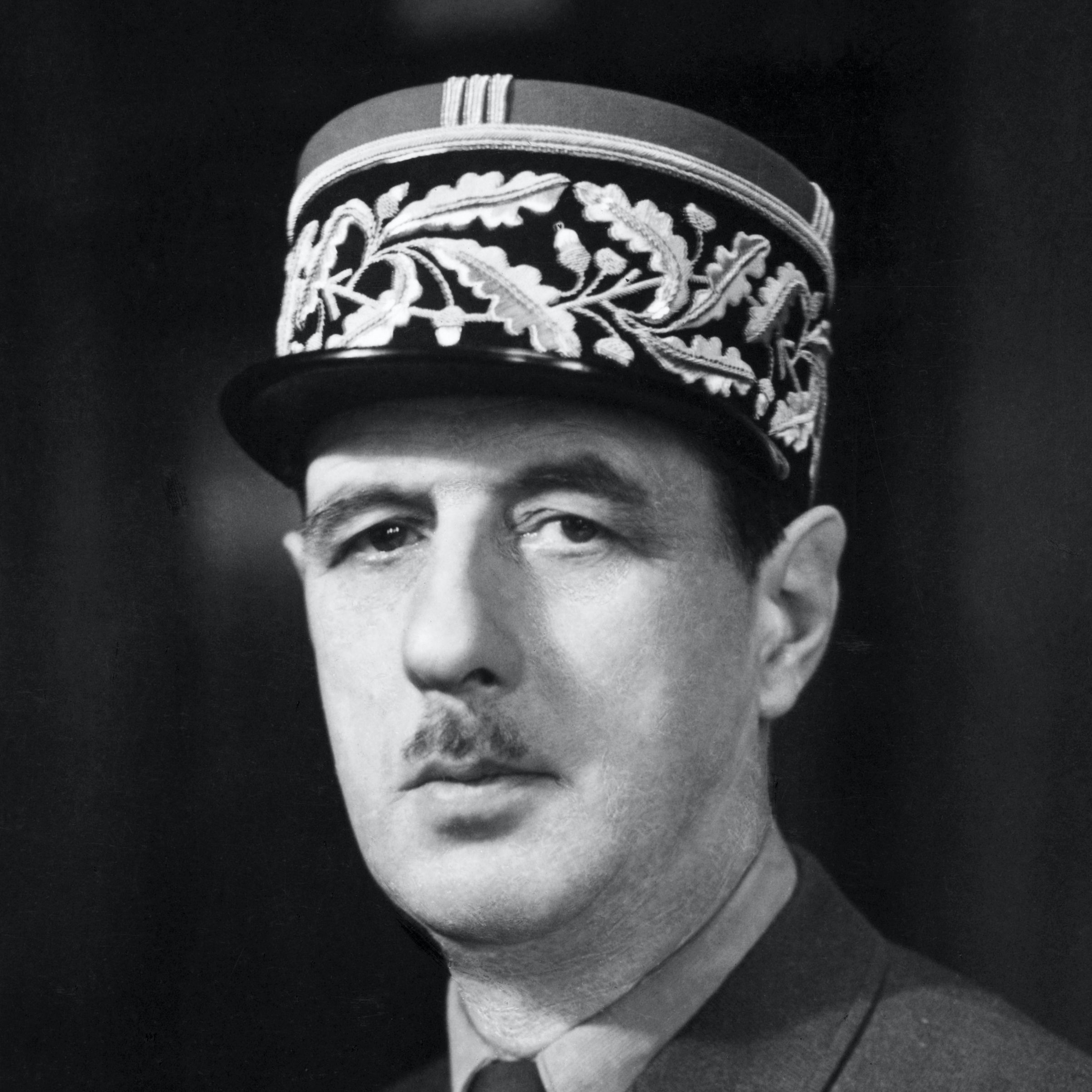
(1890-1970)
Who Was Charles de Gaulle?
Charles de Gaulle rose from French soldier in World War I to exiled leader and, eventually, president of the Fifth Republic, a position he held until 1969. De Gaulle's time as a commander in World War II would later influence his political career, providing him with a tenacious drive. His time as president was marked by the student and worker uprisings in 1968, which he responded to with an appeal for civil order.
Early Life and Military Career
The son of a philosophy and literature professor, famed French leader de Gaulle was born on November 22, 1890, into a patriotic and devoutly Catholic family. De Gaulle was a well-educated and well-read child. Early on, he dreamed of being a military leader. He enrolled at the country's top military academy, Saint-Cyr, in 1909. In 1912 he completed his studies and joined an infantry regiment that was commanded by Colonel Philippe Pétain, serving as a lieutenant.
During World War I, de Gaulle distinguished himself on the battlefield. He was wounded twice early on, and received a medal for his service. Promoted to captain, de Gaulle fought in one of the war's most deadly confrontations — the Battle of Verdun — in 1916. During the fight, he was injured and, subsequently, taken prisoner. After several failed escape attempts, de Gaulle was freed at the end of the war.
A bright and skilled soldier, de Gaulle enrolled in a special training program at the École Supérieure de Guerre after the war. He later worked with Pétain and served on France's Supreme War Council. Gaining some international experience, de Gaulle spent time in Germany and the Middle East.
Also an insightful writer, de Gaulle explored a number of military issues in his books. He published his examination of Germany, La Discorde chez l'ennemi, in 1924. Another important book was Vers l'armée de métier (1932), in which he made suggestions for creating a better army. This critical work was largely ignored by French military officials, but not by the Germans. According to some reports, the German military followed some of de Gaulle's recommendations in World War II. He and his mentor, Petain, had a falling out over another book, a military history piece entitled La France et son armée (1938).
World War II
At the time fighting broke out between Germany and France, de Gaulle was leading a tank brigade. He was temporarily appointed the brigadier general of the 4th Armored Division in May 1940. Continuing to rise up professionally, de Gaulle became the undersecretary for defense and war for French leader Paul Reynaud that June. A short while later, Reynaud was replaced by Pétain. Pétain's new government, sometimes called the Vichy government, worked out a deal with Germany to avoid further bloodshed. The Vichy regime became infamous for collaborating with the Nazis.
A dedicated patriot, de Gaulle did not accept France's surrender to Germany in 1940. He instead fled to England, where he became a leader of the Free French movement, with the support of British prime minister Winston Churchill. From London, de Gaulle broadcast a message across the English Channel to his countrymen, calling for them to continue to resist the German occupation. He also organized soldiers from French colonies to fight alongside the allied troops.
"Whatever happens, the flame of French resistance must not and shall not die." - Charles du Gaulle, June 18 1940
De Gaulle sometimes irritated other allied leaders with his demands and perceived arrogance. American President Franklin D. Roosevelt reportedly could not stand him. In fact, at the war's end, de Gaulle was purposely left out of the Yalta Conference, as Germany negotiated its surrender. He did, however, secure his nation an occupation zone in Germany and a seat on the United Nation's Security Council. De Gaulle enjoyed wide support at home and, in 1945, became president of France's provisional government. In a dispute over greater power for the country's executive branch, de Gaulle resigned this post.
For several years, de Gaulle led his own political movement, "Rally for the French People," which did not gain much momentum. He retired from politics in 1953 before returning to become president of the country in 1959.
President of the Fifth Republic
The French government, known as the Fourth Republic, began to crumble in the late 1950s, and de Gaulle once again returned to public service to help his country. He helped form the country's next government, becoming its president in January 1959. Establishing France's Fifth Republic, de Gaulle dedicated himself to improving the country's economic situation and maintaining its independence. He sought to keep France separate from the two superpowers — the United States and the Soviet Union. To show France's military relevance, de Gaulle successfully campaigned for the country to press on with its nuclear weapons program.
De Gaulle was not afraid to make controversial decisions. After coping with uprisings in Algeria for years, he helped the French colony achieve independence in 1962. This move was not widely popular at the time. De Gaulle supported the idea of a united Europe, but he wanted Europe to be free from the superpowers' influences. He fought to keep Britain out of the European Economic Community because of its close ties to the United States. In 1966, de Gaulle also pulled his country's forces out of the North Atlantic Treaty Organization (NATO), acting again on his concerns with the United States. To some, de Gaulle came off as anti-American. Though he may have been, to some extent, his actions seemed to truly reflect his deep nationalistic views.
Sometimes inflexible and intractable, de Gaulle nearly saw his government toppled by student and worker protests in 1968. He managed to restore order to the country, but left power soon after, following a battle over political and economic reforms. In April 1969, de Gaulle resigned from the presidency.
Death and Legacy
After his resignation, de Gaulle retired to his home in Colombey-les-Deux-Eglises. He had little time to enjoy the quiet life of this village, as he died of a heart attack on November 9, 1970. French President George Pompidou, who had worked closely with de Gaulle before succeeding him, delivered the terrible news to the public, saying "General de Gaulle is dead. France is a widow." France mourned the loss of its famous statesman and military leader; the country had lost one of its greatest heroes — a hero who had seen his people through war, and proved to be instrumental in his country's recovery.
Other world leaders offered up words of praise for de Gaulle. Queen Elizabeth II said that his "courage and tenacity in the allied cause during the dark years of the Second World War will never be forgotten." Two American presidents, Lyndon B. Johnson and Harry S. Truman, also sent their condolences to the people of France. President Richard Nixon was among the foreign dignitaries who attended a special service for de Gaulle, held shortly after his death, at the Notre Dame Cathedral in Paris.
Personal Life
De Gaulle married Yvonne Vendroux in 1921 and together, they had three children: Philippe (born in 1921, and who later became a French admiral and senator), Élisabeth (1924-2013) and Anne (1928-1948).
QUICK FACTS
- Name: Charles de Gaulle
- Birth Year: 1890
- Birth date: November 22, 1890
- Birth City: Lille
- Birth Country: France
- Gender: Male
- Best Known For: Charles de Gaulle rose from French soldier in World War I to exiled leader and, eventually, president of the Fifth Republic. He served as president from 1959 to 1969.
- Industries
- World War II
- World Politics
- Astrological Sign: Sagittarius
- Schools
- Military Academy of Saint-Cyr
- Nacionalities
- French
- Interesting Facts
- During his presidency, Charles de Gaulle sought to keep France separate from the two superpowers, the United States and the Soviet Union.
- De Gaulle wrote the military book, 'Vers l'armée de métier,' which was largely ignored by French military officials, but not by the Germans in World War II.
- Death Year: 1970
- Death date: November 9, 1970
- Death City: Colombey-les-deux-Églises
- Death Country: France
Fact Check
We strive for accuracy and fairness.If you see something that doesn't look right,contact us!
CITATION INFORMATION
- Article Title: Charles de Gaulle Biography
- Author: Biography.com Editors
- Website Name: The Biography.com website
- Url: https://www.biography.com/political-figures/charles-de-gaulle
- Access Date:
- Publisher: A&E; Television Networks
- Last Updated: April 7, 2021
- Original Published Date: April 2, 2014
QUOTES
- A true leader always keeps an element of surprise up his sleeve, which others cannot grasp but which keeps his public excited and breathless.
- Silence is the ultimate weapon of power.
- In politics it is necessary either to betray one's country or the electorate. I prefer to betray the electorate.
- When I am right, I get angry. Churchill gets angry when he is wrong. We are angry at each other much of the time.
- The better I get to know men, the more I find myself loving dogs.


