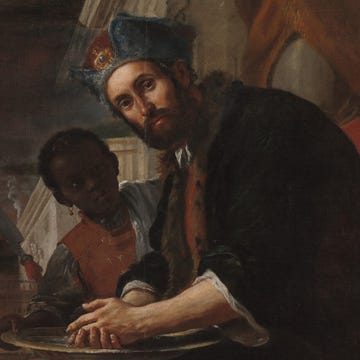
(742-814)
Synopsis
Charlemagne, also known as Charles I and Charles the Great, was born around 742 A.D., likely in what is now Belgium. Crowned King of the Franks in 768, Charlemagne expanded the Frankish kingdom, eventually establishing the Carolingian Empire. He was crowned Emperor in 800. Charlemagne's empire united Western Europe for the first time since the fall of the Roman Empire, and sparked the Carolingian Renaissance.
Early Years
Charlemagne was born around 742, the son of Bertrada of Laon (d.783) and Pepin the Short (d.768), who became king of the Franks in 751. Charlemagne’s exact birthplace is unknown, although historians have suggested Liege in present-day Belgium and Aachen in modern-day Germany as possible locations.
Similarly, little is known about the future ruler’s childhood and education, although as an adult, he displayed a talent for languages and could speak Latin and understand Greek, among other languages.
After Pepin’s death in 768, the Frankish kingdom was divided between Charlemagne and his younger brother Carloman (751-771). The brothers had a strained relationship; however, with Carloman’s death in 771, Charlemagne became the sole ruler of the Franconians.
An Empire Expands
Once in power, Charlemagne sought to unite all the Germanic peoples into one kingdom, and convert his subjects to Christianity. In order to carry out this mission, he spent the majority of his reign engaged in military campaigns. Soon after becoming king, he conquered the Lombards (in present-day northern Italy), the Avars (in modern-day Austria and Hungary) and Bavaria, among others.
Charlemagne waged a bloody, three-decades-long series of battles against the Saxons, a Germanic tribe of pagan worshippers, and earned a reputation for ruthlessness. In 782 at the Massacre of Verden, Charlemagne reportedly ordered the slaughter of some 4,500 Saxons. He eventually forced the Saxons to convert to Christianity, and declared that anyone who didn’t get baptized or follow other Christian traditions be put to death.
Family Life
In his personal life, Charlemagne had multiple wives and mistresses and perhaps as many as 18 children. He was reportedly a devoted father, who encouraged his children’s education. He allegedly loved his daughters so much that he prohibited them from marrying while he was alive.
Einhard (c. 775-840), a Frankish scholar and contemporary of Charlemagne, wrote a biography of the emperor after his death. In the work, titled “Vita Karoli Magni (Life of Charles the Great),” he described Charlemagne as “broad and strong in the form of his body and exceptionally tall without, however, exceeding an appropriate measure…His appearance was impressive whether he was sitting or standing despite having a neck that was fat and too short, and a large belly.”
Charlemagne as Emperor
In his role as a zealous defender of Christianity, Charlemagne gave money and land to the Christian church and protected the popes. As a way to acknowledge Charlemagne’s power and reinforce his relationship with the church, Pope Leo III crowned Charlemagne emperor of the Romans on December 25, 800, at St. Peter’s Basilica in Rome.
As emperor, Charlemagne proved to be a talented diplomat and able administrator of the vast area he controlled. He promoted education and encouraged the Carolingian Renaissance, a period of renewed emphasis on scholarship and culture. He instituted economic and religious reforms, and was a driving force behind the Carolingian miniscule, a standardized form of writing that later became a basis for modern European printed alphabets. Charlemagne ruled from a number of cities and palaces, but spent significant time in Aachen. His palace there included a school, for which he recruited the best teachers in the land.
In addition to learning, Charlemagne was interested in athletic pursuits. Known to be highly energetic, he enjoyed hunting, horseback riding and swimming. Aachen held particular appeal for him due to its therapeutic warm springs.
Death and Succession
According to Einhard, Charlemagne was in good health until the final four years of his life, when he often suffered from fevers and acquired a limp. However, as the biographer notes, “Even at this time…he followed his own counsel rather than the advice of the doctors, whom he very nearly hated, because they advised him to give up roasted meat, which he loved, and to restrict himself to boiled meat instead.”
In 813, Charlemagne crowned his son Louis the Pious (778-840), king of Aquitaine, as co-emperor. Louis became sole emperor when Charlemagne died, in January 814, ending his reign of more than four decades. At the time of his death, his empire encompassed much of Western Europe.
Charlemagne was buried at the cathedral in Aachen. In the ensuing decades, his empire was divided up among his heirs, and by the late 800s, it had dissolved. Nevertheless, Charlemagne became a legendary figure endowed with mythical qualities. In 1165, under Emperor Frederick Barbarossa (1122-1190), Charlemagne was canonized for political reasons; however, the church today does not recognize his sainthood.
Biography courtesy of History.com
QUICK FACTS
- Name: Charlemagne
- Birth Year: 742
- Birth Country: Belgium
- Gender: Male
- Best Known For: Charlemagne, also known as Charles the Great, was the founder of the Carolingian Empire, best known for uniting Western Europe for the first time since the fall of the Roman Empire.
- Industries
- Business and Industry
- Law
- Politics and Government
- War and Militaries
- Art
- Christianity
- Occupations
- Emperor
- King
- Death Year: 814
- Death date: January 28, 814
- Death City: Aachen
- Death Country: Germany
Fact Check
We strive for accuracy and fairness.If you see something that doesn't look right,contact us!
CITATION INFORMATION
- Article Title: Charlemagne Biography
- Author: Biography.com Editors
- Website Name: The Biography.com website
- Url: https://www.biography.com/royalty/charlemagne
- Access Date:
- Publisher: A&E; Television Networks
- Last Updated: August 24, 2019
- Original Published Date: April 2, 2014