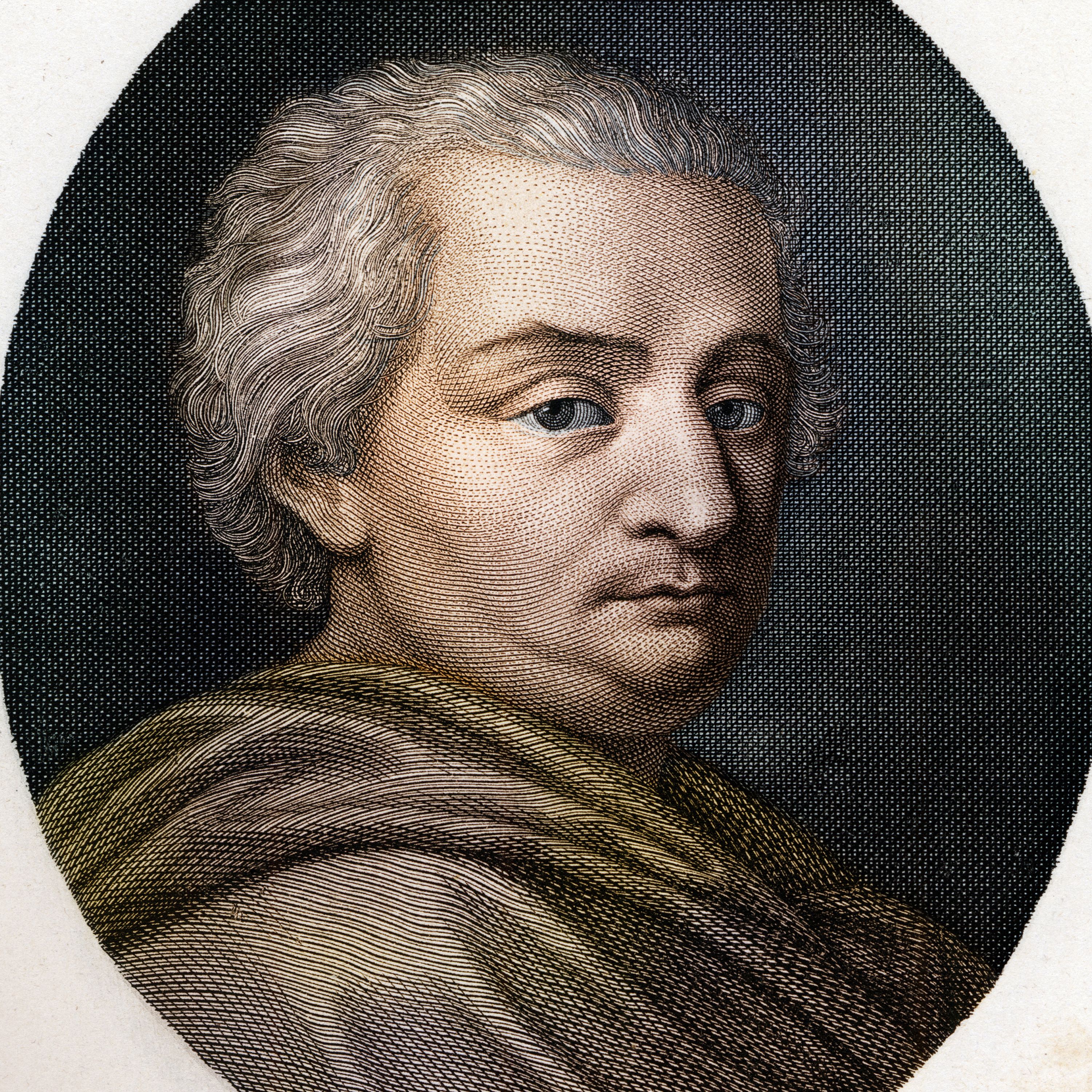
(1738-1794)
Who Was Cesare Beccaria?
Cesare Beccaria was a criminologist and economist. In the early 1760s, Beccaria helped form a society called "the academy of fists," dedicated to economic, political and administrative reform. In 1764, he published his famous and influential criminology essay, "On Crimes and Punishments." In 1768, he started a career in economics, which lasted until his death.
Early Life
Beccaria was born March 15, 1738 in Milan, Italy. His father was an aristocrat born of the Austrian Habsburg Empire, but earned only a modest income.
Beccaria received his primary education at a Jesuit school in Parma, Italy. He would later describe his early education as "fanatical" and oppressive of "the development of human feelings." Despite his frustration at school, Beccaria was an excellent math student. Following his education at the Jesuit school, Beccaria attended the University of Pavia, where he received a law degree in 1758.
Even in his early life, Beccaria was prone to mood swings. He tended to vacillate between fits of anger and bursts of enthusiasm, often followed by periods of depression and lethargy. He was shy in social settings, but cherished his relationships with friends and family.
In 1760, Beccaria extended his family by proposing to Teresa Blasco. Teresa was just 16 years old, and her father strongly objected to the engagement. A year later, the couple eloped. In 1762, they welcomed a baby girl, the first of the couple’s three children.
Also among those people that Beccaria held particularly dear were his friends Pietro and Alessandro Verri. In collaboration with the Verri brothers, Beccaria formed an intellectual/literary society called "the academy of fists." In line with the principles of the Enlightenment, the society was dedicated to "waging relentless war against economic disorder, bureaucratic tyranny, religious narrow-mindedness, and intellectual pedantry." Its main goal was to promote economic, political and administrative reform.
To this effect, academy members encouraged Beccaria to read French and British writings on the Enlightenment, and to take a stab at writing himself. To fulfill his friends’ assignment, Beccaria composed his first published essay, "On Remedies for the Monetary Disorders of Milan in the Year 1762."
Criminal Justice
Also spurred by his involvement in the "academy of fists" was Beccaria’s most famous and influential essay, "On Crimes and Punishments," published in 1764. "On Crimes and Punishments" is a thorough treatise exploring the topic of criminal justice. Because Beccaria’s ideas were critical of the legal system in place at the time, and were therefore likely to stir controversy, he chose to publish the essay anonymously -- for fear of government backlash.
In actuality, the treatise was extremely well-received. Catherine the Great publicly endorsed it, while thousands of miles away in the United States, founding fathers Thomas Jefferson and John Adams quoted it. Once it was clear that the government approved of his essay, Beccaria republished it, this time crediting himself as the author.
Three tenets served as the basis of Beccaria’s theories on criminal justice: free will, rational manner, and manipulability. According to Beccaria — and most classical theorists — free will enables people to make choices. Beccaria believed that people have a rational manner and apply it toward making choices that will help them achieve their own personal gratification.
In Beccaria’s interpretation, law exists to preserve the social contract and benefit society as a whole. But, because people act out of self-interest and their interest sometimes conflicts with societal laws, they commit crimes. The principle of manipulability refers to the predictable ways in which people act out of rational self-interest and might therefore be dissuaded from committing crimes if the punishment outweighs the benefits of the crime, rendering the crime an illogical choice.
In "On Crimes and Punishments," Beccaria identified a pressing need to reform the criminal justice system, citing the then-present system as barbaric and antiquated. He went on to discuss how specific laws should be determined, who should make them, what they should be like and whom they should benefit. He emphasized the need for adequate but just punishment, and went so far as to explain how the system should define the appropriate punishment for each type of crime.
Unlike documents before it, "On Crimes and Punishments" sought to protect the rights of criminals as well as the rights of their victims. "On Crimes and Punishments" also assigned specific roles to the various members of the courts. The thorough treatise included a discussion of crime-prevention strategies.
Economics
In addition to his fascination with criminal law, Beccaria was still drawn to the field of economics. In 1768, he was appointed the Chair in Public Economy and Commerce at the Palatine School in Milan. For the next two years, he also served as a lecturer there. Based on these lectures, Beccaria created an economic analysis entitled "Elements of Public Economy." In it he pioneered the discussion of such topics as division of labor. "Elements of Public Economy" was eventually published in 1804, a decade after Beccaria’s death.
Beccaria’s economics career also entailed serving on the Supreme Economic Council of Milan. This public position enabled him to strive for the same goal — economic reform — that he had set with "the academy of fists" so many years ago. While in office, Beccaria focused largely on the issues of public education and labor relations. He also created a report on the system of measures that led France to start using the metric system.
Beccaria’s career in economics was productive. His work in analysis helped paved the way for later theorists like Thomas Malthus. However, Beccaria failed to match the astronomical level of success he had previously achieved in the criminal justice field. While retaining his career in economics, in 1790 Beccaria served on a committee that promoted civil and criminal law reform in Lombardy, Italy.
Death and Legacy
Near the end of his life, Beccaria was depressed by the excesses of the French Revolution and withdrew from his family and friends. He died on November 28, 1794, in his birthplace of Milan, Italy.
Following his death, talk of Beccaria spread to France and England. People speculated as to whether Beccaria’s lack of recent writing on criminal justice was evidence that he had been silenced by the British government. In fact, Beccaria, prone to periodic bouts of depression and misanthropy, had grown silent on his own.
A forerunner in criminology, Beccaria’s influence during his lifetime extended to shaping the rights listed in the U.S. Constitution and the Bill of Rights. "On Crimes and Punishments" served as a guide to the founding fathers.
Beccaria’s theories, as expressed in his treatise "On Crimes and Punishments," have continued to play a role in recent times. Recent policies impacted by his theories include, but are not limited to, truth in sentencing, swift punishment and the abolishment of the death penalty in some U.S. states. While many of Beccaria’s theories are popular, some are still a source of heated controversy, even more than two centuries after the famed criminologist’s death.
QUICK FACTS
- Name: Cesare Beccaria
- Birth Year: 1738
- Birth date: March 15, 1738
- Birth City: Milan
- Birth Country: Italy
- Gender: Male
- Best Known For: Cesare Beccaria was one of the greatest minds of the Age of Enlightenment in the 18th century. His writings on criminology and economics were well ahead of their time.
- Industries
- Crime and Terrorism
- Education and Academia
- Law
- Politics and Government
- Astrological Sign: Pisces
- Nacionalities
- Italian
- Death Year: 1794
- Death date: November 28, 1794
- Death City: Milan
- Death Country: Italy
Fact Check
We strive for accuracy and fairness. If you see something that doesn't look right, contact us!