(1961-)
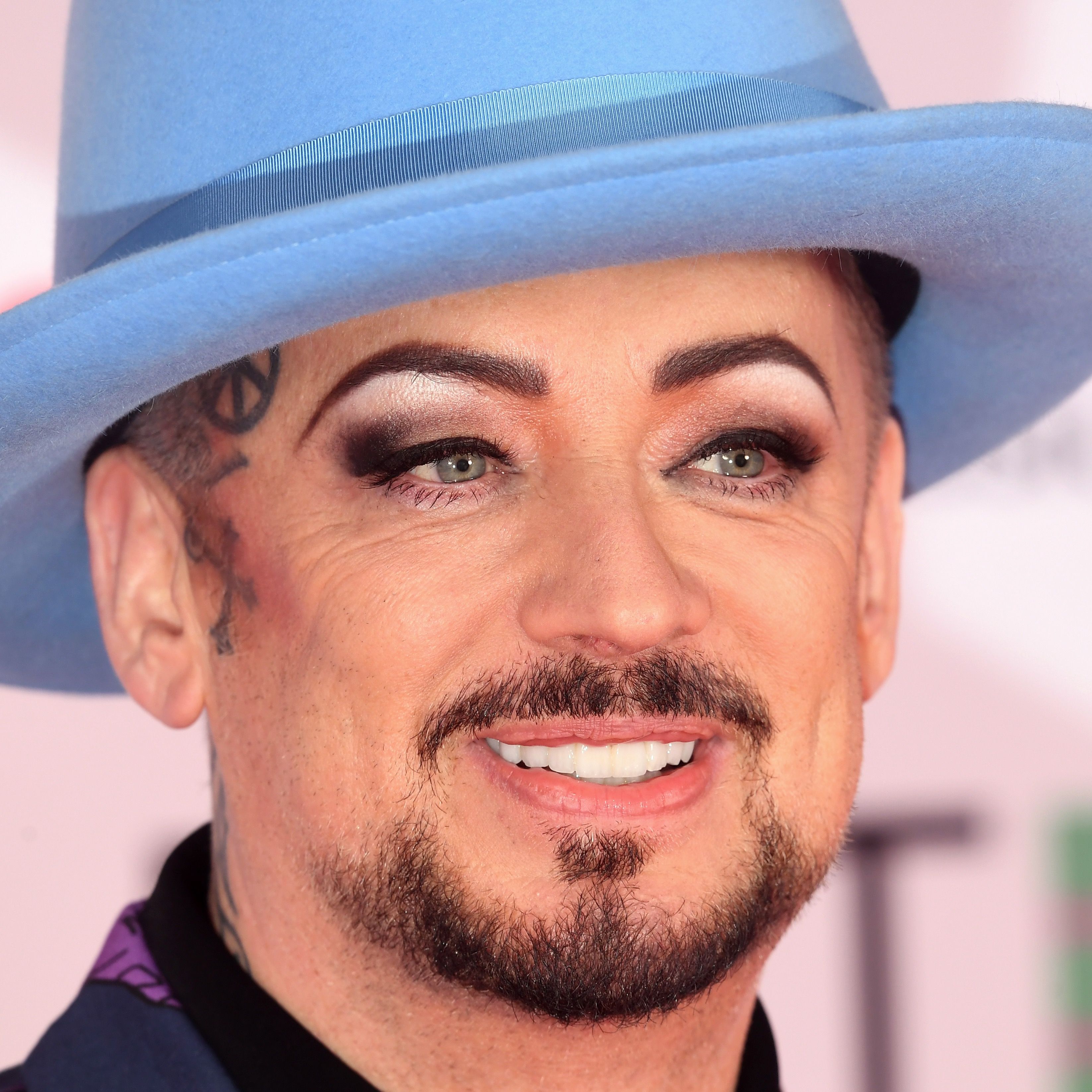
Who Is Boy George?
Boy George's band Culture Club released their debut album, Kissing To Be Clever, in 1982, and their third single, "Do You Really Want To Hurt Me?" was a huge hit, reaching the No. 1 spot in 16 different countries. The band found quick success, but George's drug habit started to show in 1985. Although he has released solo albums, George's personal life has been the focus more than his music.
Early Life
Boy George was born George Alan O'Dowd on June 14, 1961, in Eltham, London, to parents Gerry and Dinah O'Dowd. George grew up in a lively household with his four brothers and one sister. Despite being part of the large working class Irish brood, George claims he had a lonely childhood, referring to himself as the "pink sheep" of the family.
To stand out in the male-dominated household, George created his own image, which he came to depend on. "It didn't bother me to walk down the street and to be stared at. I loved it," he later reminisced.
George didn't exactly conform to the typical school student archetype, either. With a leaning more toward the arts rather than science and math, he found it hard to fit within traditional masculine stereotypes. With his schoolwork suffering, and an ongoing battle of wits between him and his teachers, it wasn't long before the school gave up and expelled George over his increasingly outlandish behavior and outrageous clothes and make-up.
Soon George found himself out of school, and without a job. He took any work he could find that paid him enough money to live on including a job picking fruit; a stint as a milliner; and even a gig as a make-up artist with the Royal Shakespeare Company, where he picked up some handy techniques for his own personal use.
Forming the Culture Club
By the 1980s, the New Romantic Movement had emerged in the U.K. Followers of the New Romantic period, influenced heavily by artists such as David Bowie, often dressed in grand caricatures of the 19th century English Romantic period. This included exaggerated upscale hairstyles and fashion statements. Men typically wore androgynous clothing and makeup, such as eyeliner.
The style became a calling card for George, whose flamboyance fit their beliefs perfectly. The attention the New Romantics attracted inevitably created many new headlines for the press. It wasn't long before George was giving interviews based purely on his appearance.
George's outrageous style caught the attention of Malcolm McLaren, the manager of the infamous punk group the Sex Pistols. McLaren was also managing a group called Bow Wow Wow, which was fronted by Burmese 16-year-old Annabella Lwin. McLaren felt he needed someone to give Lwin a bit more stage and vocal presence, so he arranged for George to perform with the group.
George made a few appearances to much audience acclaim, and inevitable friction between the two big personalities began to surface. However George, by now, felt inspired to form his own group. The answer came in the form of The Sex Gang Children. Bassist Mikey Craig and drummer Jon Moss were next to join the group, followed by Roy Hay. The group soon abandoned their original name, instead settling on Culture Club. The name was a joke in reference to the group members' various backgrounds: George was Irish, Craig was Jamaican and British, Moss was Jewish and Hay was an Englishman.
International Pop Star
Success came early for the band. They signed with Virgin Records in the U.K. and Epic Records in America, releasing their debut album, Kissing To Be Clever, in 1982. It was their third single from that album, "Do You Really Want To Hurt Me?" that scored a huge success for the group. The song reached the No. 1 spot in 16 different countries.
Culture Club already had the distinction of being the first group since the Beatles to have three songs from their debut album become top 10 hits on the Billboard Hot 100. The group's second album, Colour By Numbers (1983) was also a success, with the single "Karma Chameleon" rocketing to the No. 1 spot in numerous countries including the U.S., where it stayed for four weeks.
George soon became a household name, making him a natural choice for one of the lead vocals on the Band Aid single "Do They Know It's Christmas?" in 1984. However the pressure of fame began to take its toll, and by late 1985 George had developed an addiction to heroin. Culture Club began to lose their way musically. Work on their fourth album From Luxury To Heartache (1986) proved to be a headache as recording sessions dragged on for hours.
Personal Life
In July of that same year, George was arrested in the U.K. for possession of cannabis. A few days later, the band's keyboardist, Michael Rudetski, was found dead in George's home. The coroner's report revealed that he had suffered a heroin overdose.
During his time in Culture Club, George embarked on a relationship with drummer Jon Moss, and he has claimed that some of the songs he wrote during this period were aimed at Moss directly. The pair's romance did not last though, with speculation that Moss had broken off his engagement to a woman to be with George, but was never entirely comfortable in a homosexual relationship. Moss has since gone on to marry a woman and has several children.
Clearly the much-hyped furor over the band peaked too early and in late 1986, after their U.S. tour was canceled, Culture Club disbanded. Despite his ongoing battles with drug addiction, George began recording his first solo album. In 1987 Sold was released as a major success, but George never really managed to duplicate the same level of exposure in the U.S.
Over the years, George continued to release various solo albums and even formed his own record label in the early '90s. His most significant acclaim during the 90s was his 1992 hit single "The Crying Game," which featured in the film of the same name. The song reached the top 20 on the U.S. charts.
After a fall out with Virgin Records in the mid '90s, George's work was poorly promoted and subsequently failed to alight any kind of praise. Culture Club reunited briefly back in 1998 at the Big Rewind tour in America alongside Human League, and later the same year managed to secure a top five single in the U.K. with "I Just Wanna Be Loved."
In 2006, the band decided to again reunite; however, George declined to join them for this tour. As a result, he was replaced. After only one showcase and one live show, the project was shelved.
On Stage
Although George failed to reach the same level of acclaim as a solo artist in comparison to the Culture Club days, he has fared better in his second career as a notable music DJ. He began DJing in the early 1990s and has since enjoyed critical acclaim both here in the UK and in the US.
In 2002, George was joined by a hoard of celebrities for the premiere of his new musical, Taboo. The star had penned the story of his own rise to fame, including colorful characters from his past. The musical featured a host of new songs written by George as well as Culture Club's No. 1 singles, "Do You Really Want to Hurt Me?" and "Karma Chameleon." Open auditions were held to find actors and singers that resembled the stars of the 80s. Scottish actor Euan Morton won the part of the dread-locked George. Matt Lucas, at the time most famed for his George Dawes character on BBC's Shooting Stars, took the role of flamboyant performance artist Leigh Bowery, who died of an AIDS-related illness in 1994.
American comedienne Rosie O'Donnell saw the musical and was so enamored that she decided to finance the production for Broadway, too. The show opened in February 2003 but after just 100 performances, closed, hampered by a barrage of negative reviews and struggles to meet financial ends. The U.K. production, however, continued to be a success. A DVD release and book accompanied the play.
Trouble with the Law
Boy George's demons have gained ongoing media attention after his drug problems came to light in the '80s. In 2005, nearly 10 years after his first public drug expose, George was arrested in Manhattan on suspicion of possessing cocaine after it was found in his apartment.
After failing to appear in court the following year for the same drugs charge, a judge issued a warrant for his arrest. George's no-show for his initial court date resulted in a $1,000 fine and a spell of community service. In August 2006, George reported for trash duty on the streets of New York, making the media's day with snaps of the usually flamboyant star in combats and trainers with a broom and disposable gloves.
His troubles with law, however, continued. In November 2007, he was sent to trial on charges for falsely imprisoning a male escort by chaining him to a wall. The alleged incident had taken place at his flat in Hackney earlier in the year. On January 16, 2009, he was sentenced to 15 months in prison for the offense. Initially he was sent to HMP Pentonville in London and was later transferred to HMP Edmunds Hill in Newmarket, Suffolk, to serve out his time.
Recent Projects
In 2013, Boy George put out This Is What I Do, his first studio album in nearly 20 years. He also debuted his new, improved lifestyle around this time as well. Boy George had shed a substantial amount of weight and embraced his sobriety. As he explained to the Metro newspaper, "I am in a really good place and really enjoying being busy." He explained that he'd rather focus on work "than going out clubbing."
Boy George also delighted his longtime fans the following year with news of a Culture Club reunion. The band announced plans for several concerts to be held in late 2014 and are working together on recording some material in the studio as well.
In January 2016 Boy George announced he would replace Tom Jones as a mentor on the U.K. version of The Voice. Adding more to his reality TV projects, he is also said to be joining the eighth season of The Celebrity Apprentice on NBC.
QUICK FACTS
- Name: Boy George
- Birth Year: 1961
- Birth date: June 14, 1961
- Birth City: Eltham
- Birth Country: England
- Gender: Male
- Best Known For: Boy George is a British singer, known for his flamboyant and androgynous image, who once fronted the band Culture Club.
- Industries
- Pop
- Astrological Sign: Gemini
Fact Check
We strive for accuracy and fairness.If you see something that doesn't look right,contact us!
CITATION INFORMATION
- Article Title: Boy George Biography
- Author: Biography.com Editors
- Website Name: The Biography.com website
- Url: https://www.biography.com/musicians/boy-george
- Access Date:
- Publisher: A&E; Television Networks
- Last Updated: October 27, 2021
- Original Published Date: April 2, 2014
QUOTES
- It didn't bother me to walk down the street and to be stared at. I loved it.