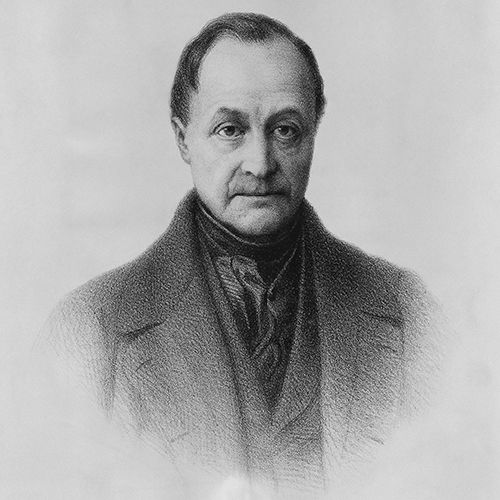
(1798-1857)
Who Was Auguste Comte?
French philosopher Auguste Comte grew up in the wake of the French Revolution. He rejected religion and royalty, focusing instead on the study of society, which he named "sociology." He broke the subject into two categories: the forces holding society together ("social statics") and those driving social change ("social dynamics"). Comte's ideas and use of scientific methods greatly advanced the field.
Early Life
Isidore Marie Auguste François Xavier Comte was born on January 19, 1798, in Montpellier, France. He was born in the shadow of the French Revolution and as modern science and technology gave birth to the Industrial Revolution. During this time, European society experienced violent conflict and feelings of alienation. Confidence in established beliefs and institutions was shattered. Comte spent much of his life developing a philosophy for a new social order amidst all the chaos and uncertainty.
Comte’s father, Louis, a government tax official, and his mother, Rosalie (Boyer) Comte, were both monarchists and devout Roman Catholics. While attending the University of Montpellier, Comte abandoned these attitudes in favor of republicanism inspired by the French Revolution, which would influence his later work.
In 1814, he entered École Polytechnique and proved to be a brilliant mathematician and scientist. He left school before graduating and settled in Paris with no viable way to support himself. He earned a meager living teaching mathematics and journalism while deep in the study of economics, history and philosophy.
At 19, Comte met Henri de Saint-Simon, a social theorist interested in utopian reform and an early founder of European socialism. Deeply influenced by Saint-Simon, Comte became his secretary and collaborator. In 1824, the partnership ended over disputed authorship of the pair’s writings, but Saint-Simon’s influence remained throughout Comte’s life.
Philosophical Ideas and Sociology
On his own, Comte developed a social doctrine based on scientific principles. In 1826, he began presenting a series of lectures to a group of distinguished French intellectuals. However, about one-third of the way through the lecture series, he suffered a nervous breakdown. Despite periodic hospitalization over the next 15 years, he produced his major work, the six-volume Course of Positive Philosophy. In this work, Comte argued that, like the physical world, society operated under its own set of laws.
Comte’s efforts furthered the study of society and the development of sociology. During this time, he supported himself with a post at École Polytechnique, but clashed with administrators and was dismissed in 1842. That same year, he divorced his wife, Caroline Massin Comte, after 17 years of acrimonious marriage. From then on, he relied on friends and benefactors to support him.
In 1844, Comte became involved with Clotilde de Vaux, a French aristocrat and writer. Since she wasn’t divorced from her philandering husband, her relationship with Comte remained platonic, though the two were deeply in love. After her death, in 1846, Comte wrote the System of Positive Polity. In his formulation of a “religion of humanity,” Comte proposed a religious order based on reason and humanity, emphasizing morality as the cornerstone of human political organization.
Death
Comte continued to refine and promote his “new world order,” attempting to unify history, psychology and economics through the scientific understanding of society. His work was widely promulgated by Europe’s intellectuals and influenced the thinking of Karl Marx, John Stuart Mill and George Eliot. Comte died of stomach cancer in Paris on September 5, 1857. Though self-centered and egocentric, Comte devoted himself to the betterment of society.
QUICK FACTS
- Name: Auguste
- Birth Year: 1798
- Birth date: January 19, 1798
- Birth City: Montpellier, Herault
- Birth Country: France
- Gender: Male
- Best Known For: French philosopher Auguste Comte greatly advanced the field of social science, giving it the name "sociology" and influenced many 19th-century social intellectuals.
- Industries
- Education and Academia
- Journalism and Nonfiction
- Astrological Sign: Capricorn
- Schools
- Lycee Joffre
- University of Montpellier
- École Polytechnique
- Nationalities
- French
- Death Year: 1857
- Death date: September 5, 1857
- Death City: Paris
- Death Country: France
Fact Check
We strive for accuracy and fairness. If you see something that doesn't look right, contact us!
QUOTES
- The sacred formula of positivism: love as a principle, the order as a foundation, and progress as a goal.
- The dead govern the living.
- To understand a science it is necessary to know its history.
- Men are not allowed to think freely about chemistry and biology: why should they be allowed to think freely about political philosophy?