(1892-1962)
Who Was Augusta Savage?
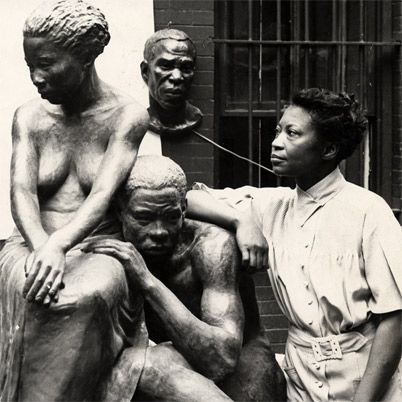
Born in Florida in 1892, Augusta Savage began creating art as a child by using the natural clay found in her hometown. After attending Cooper Union in New York City, she made a name for herself as a sculptor during the Harlem Renaissance and was awarded fellowships to study abroad. Savage later served as a director for the Harlem Community Center and created the monumental work The Harp for the 1939 New York World's Fair. She spent most of her later years in Saugerties, New York, before her death from cancer in 1962.
Early Life
Savage was born Augusta Christine Fells on February 29, 1892, in Green Cove Springs, Florida. Part of a large family, she began making art as a child, using the natural clay found in her area. Skipping school at times, she enjoyed sculpting animals and other small figures. But her father, a Methodist minister, didn't approve of this activity and did whatever he could to stop her. Savage once said that her father "almost whipped all the art out of me."
Despite her father's objections, Savage continued to make sculptures. When the family moved to West Palm Beach, Florida, in 1915, she encountered a new challenge: a lack of clay. Savage eventually got some materials from a local potter and created a group of figures that she entered in a local county fair. Her work was well received, winning a prize and along the way the support of the fair's superintendent, George Graham Currie. He encouraged her to study art despite the racism of the day.
Trailblazing Career in Art
After a failed attempt to establish herself as a sculptor in Jacksonville, Florida, Savage moved to New York City in the early 1920s. Although she struggled financially throughout her life, she was admitted to study art at Cooper Union, which did not charge tuition. Before long, the school gave her a scholarship to help with living expenses as well. Savage excelled, finishing her course work in three years instead of the usual four.
While at Cooper Union, she had an experience that would greatly influence her life and work: In 1923, Savage applied to a special summer program to study art in France, but was rejected because of her race. She took the rejection as a call to action and sent letters to the local media about the program selection committee's discriminatory practices. Savage's story made headlines in many newspapers, although it wasn't enough to change the group's decision. One committee member, Herman MacNeil, regretted the ruling and invited Savage to further hone her craft at his Long Island studio.
Savage soon started to make a name for herself as a portrait sculptor. Her works from this time include busts of such prominent African Americans as W. E. B. Du Bois and Marcus Garvey. Savage was considered to be one of the leading artists of the Harlem Renaissance, a preeminent African American literary and artistic movement of the 1920s and '30s.
Eventually, following a series of family crises, Savage got her opportunity to study abroad. She was awarded a Julius Rosenwald fellowship in 1929, based in part on a bust of her nephew entitled Gamin. Savage spent time in Paris, where she exhibited her work at the Grand Palais. She earned a second Rosenwald fellowship to continue her studies for another year, and a separate Carnegie Foundation grant allowed her to travel to other European countries.
Savage returned to the United States while the Great Depression was in full swing. With portrait commissions hard to come by, she began teaching art and established the Savage Studio of Arts and Crafts in 1932. In mid-decade, she became the first Black artist to join what was then known as the National Association of Women Painters and Sculptors.
Savage assisted many burgeoning African American artists, including Jacob Lawrence and Norman Lewis, and lobbied the Works Projects Administration (WPA) to help other young artists find work during this time of financial crisis. She also helped found the Harlem Artists' Guild, which led to a directorial position at the WPA's Harlem Community Center.
World's Fair Commission
Savage was then commissioned to create a sculpture for the 1939 New York World's Fair. Inspired by the words of the poem "Lift Every Voice and Sing," by James Weldon Johnson (who had also previously modeled for Savage), she created The Harp. Standing 16 feet tall, the work reinterpreted the musical instrument to feature 12 singing African American youth in graduated heights as its strings, with the harp's sounding board transformed into an arm and a hand. In the front, a kneeling young man offered music in his hands. Although considered one of her major works, The Harp was destroyed at the end of the fair.
Having lost her directorial position at the Harlem Community Center while working on The Harp, Savage sought to create other art centers in the area. One notable work from this period was The Pugilist (1942) — a confident and defiant figure who appears prepared to take on whatever might come his way — but she grew frustrated over her struggles to reestablish herself. In 1945, she left the city and moved to a farm in Saugerties, New York.
Later Years, Death and Legacy
Augusta Savage spent most of her remaining years in the solitude of small-town life. She taught children in summer camps, dabbled in writing and continued with her art as a hobby.
Savage was married three times: The first was in 1907 to John T. Moore, with whom she had her lone child, Irene. Moore died some years afterward. Around 1915, she married carpenter James Savage, a union that ended in divorce. In 1923, she married Robert Lincoln Poston, an associate of Marcus Garvey's, but was again widowed when he passed away the following year. When Savage became ill late in life, she moved back to New York City to be with her daughter and her family.
Savage died of cancer on March 26, 1962, in New York City. While she was all but forgotten at the time of her death, Savage is remembered today as a great artist, activist and arts educator, serving as an inspiration to the many that she taught, helped and encouraged.
QUICK FACTS
- Name: Augusta Savage
- Birth Year: 1892
- Birth date: February 29, 1892
- Birth State: Florida
- Birth City: Green Cove Springs
- Birth Country: United States
- Gender: Female
- Best Known For: Sculptor Augusta Savage was one of the leading artists of the Harlem Renaissance as well as an influential activist and arts educator.
- Industries
- Education and Academia
- Art
- Astrological Sign: Pisces
- Schools
- Cooper Union
- Death Year: 1962
- Death date: March 26, 1962
- Death State: New York
- Death City: New York
- Death Country: United States
Fact Check
We strive for accuracy and fairness.If you see something that doesn't look right,contact us!
CITATION INFORMATION
- Article Title: Augusta Savage Biography
- Author: Biography.com Editors
- Website Name: The Biography.com website
- Url: https://www.biography.com/artists/augusta-savage
- Access Date:
- Publisher: A&E; Television Networks
- Last Updated: July 9, 2020
- Original Published Date: April 2, 2014