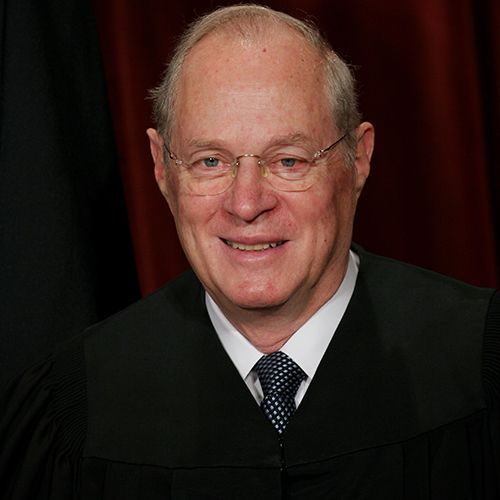
(1936-)
Who Is Anthony Kennedy?
Born in 1936 in Sacramento, California, Anthony Kennedy went on to graduate from Harvard Law School and teach constitutional law. He joined the U.S. Court of Appeals in the mid-1970s and in 1988, after being appointed by President Ronald Reagan, he became a Supreme Court Justice. Initially known for his conservative views, he became the court's prominent swing vote over his 30 years on the bench. In June 2018, he announced he would be retiring at the end of the following month.
Early Life and Career
Anthony McLeod Kennedy was the second child born to Anthony J. Kennedy and Gladys McLeod. His father started out as a dock worker in San Francisco and worked his way through college and law school to build a substantial practice as a lawyer and lobbyist in the California legislature. His mother was active in civic affairs. As a young boy, Kennedy came in contact with prominent politicians and developed an affinity for the world of government and public service.
An honor student for much of his high school years at McClatchy High School in Sacramento, California, Kennedy graduated in 1954. Following in his mother’s footsteps, he enrolled at Stanford University. There he became enthralled with constitutional law and was said by one of his professors to be a brilliant student.
Kennedy completed his graduation requirements in three years and attended the London School of Economics for a year before receiving his bachelor's degree in political science from Stanford University in 1958. He then attended Harvard Law School, graduating cum laude in 1961. He subsequently served a year in the California Army National Guard.
In 1962, Kennedy passed the bar exam and practiced law in San Francisco and Sacramento, California. When his father died unexpectedly in 1963, Kennedy took over the law practice. That same year, he married Mary Davis, who he had known for several years. Together, they would have three children.
Just after starting at the law office, Kennedy began acting on what would be his lifelong interest in education. He accepted a position as professor of constitutional law at the University of the Pacific's McGeorge School of Law, where he taught from 1963 to 1988.
Lawyer and Judge
In his years of private practice, Kennedy followed his father’s political affiliation in the Republican Party. He worked as a lobbyist in California and became friends with Ed Meese, another lobbyist with close ties to Ronald Reagan. Kennedy assisted then-Governor Reagan in drafting Proposition 1, a ballot initiative to cut state spending.
Though the proposition failed, Reagan was very appreciative of the assistance and recommended Kennedy to President Gerald Ford for an appointment to the U.S. Court of Appeals for the Ninth Circuit. At 38, Kennedy was the youngest federal appeals court judge in the country.
During the Carter administration, the Ninth Circuit gained a majority of liberal thinking judges and Kennedy became the head of the court’s conservative minority. His calm demeanor and friendly personality kept the deliberations civil on the often divided court. Setting aside ideology, Kennedy took a case-by-case approach, keeping his opinions narrow and avoiding sweeping conclusions and rhetoric. This tactic earned him the respect of opposing judges and lawyers alike.
Kennedy's distinguished tenure on the Ninth Circuit put him on the shortlist of candidates to fill the seat of retiring Supreme Court Justice Lewis Powell in 1987. Instead, President Reagan nominated Robert H. Bork, whose outspoken demeanor and sharply conservative views on constitutional law and social policy led to his rejection by the Senate. The quieter Kennedy was eventually nominated and was unanimously confirmed.
On the Bench
Early in his tenure, Kennedy proved to be markedly conservative. In his first term, he voted with Chief Justice William H. Rehnquist and Justice Antonin Scalia, two of the court's most conservative members, more than 90 percent of the time.
With Justice Sandra Day O'Connor, Kennedy contributed critical votes that led to winning conservative majorities in cases limiting congressional authority under the commerce clause of the Constitution of the United States and striking down portions of gun-control legislation. In subsequent years, however, his decisions were more independent.
Parting ways with his conservative colleagues in 1992, Justice Kennedy co-authored (with O'Connor and Justice David Souter) the court's majority opinion in Planned Parenthood of Southeastern Pennsylvania v. Casey, which held that legal restrictions on access to abortion must not constitute an “undue burden” on a woman's exercise of her right to abortion as established in Roe v. Wade (1973).
Kennedy was a surprising and unpredictable justice on the Supreme Court, displaying thoughtful independence that, at times, fails to reflect any particular ideology. His episodic departure from conservative jurisprudence reflected a civil-libertarian perspective on certain individual rights.
For example, although he was generally deferential to the government on criminal law and related matters, he voted, along with Scalia and the court's liberals, to declare unconstitutional a Texas law that prohibited the desecration of the American flag, on the grounds that the Constitution protects such acts as symbolic speech.
He also wrote the court's decision in Romer v. Evans (1996), which voided an amendment to the Colorado state constitution that prohibited state and local governments from enacting laws that would protect the rights of gays, lesbians and bisexuals. In Lawrence v. Texas (2003), he declared Texas' law criminalizing sodomy between two consenting adults of the same sex unconstitutional.
Obamacare and Same-Sex Marriage
On June 25, 2015, Kennedy voted in favor of upholding a key component of the 2010 Affordable Care Act, President Barack Obama’s health care law, also known as Obamacare. The 6 to 3 ruling preserved the law, allowing the federal government to provide nationwide tax subsidies to help Americans buy health insurance. Justice Kennedy joined fellow Republican appointee Chief Justice John Roberts and four Democratic appointees — Sonia Sotomayor, Elena Kagan, Ruth Bader Ginsburg, and Stephen Breyer — in the majority ruling.
On June 26, 2015, one day after the ruling on health care, the Supreme Court announced a landmark 5 to 4 ruling guaranteeing a right to same-sex marriage. Justice Kennedy wrote the majority decision in which he stated: “No union is more profound than marriage, for it embodies the highest ideals of love, fidelity, devotion, sacrifice, and family. In forming a marital union, two people become something greater than once they were. As some of the petitioners in these cases demonstrate, marriage embodies a love that may endure even past death. It would misunderstand these men and women to say they disrespect the idea of marriage. Their plea is that they do respect it, respect it so deeply that they seek to find its fulfillment for themselves. Their hope is not to be condemned to live in loneliness, excluded from one of civilization’s oldest institutions. They ask for equal dignity in the eyes of the law. The Constitution grants them that right.”
Justice Kennedy joined more liberal Justices Ginsburg, Breyer, Sotomayor and Kagan in the landmark decision. Dissenting justices included Chief Justice Roberts, Justices Clarence Thomas, Samuel Alito and Scalia, all of whom wrote opinions expressing that it was not the Supreme Court’s place to decide same-sex marriage and it was an overreach of the court’s power. Justice Scalia called the ruling “a threat to American democracy” while Justice Alito wrote: "Even enthusiastic supporters of same-sex marriage should worry about the scope of the power that today's majority claims. Today's decision shows that decades of attempts to restrain this Court's abuse of its authority have failed."
The issue of same-sex marriage returned with Masterpiece Cakeshop v. Colorado Civil Rights Commission, stemming from Colorado baker Jack Phillips' refusal to design a custom cake for a gay couple's wedding due to his religious beliefs. The Supreme Court decided in favor of Phillips in June 2018, with Kennedy writing the majority opinion that decried the "compromised" public hearing the baker endured in Colorado and cited the importance of anti-discrimination laws remaining "neutral toward religion."
Kennedy also acknowledged that the high court was just beginning to wade into the murky waters of religious freedom vs. discrimination, writing, "the outcome of cases like this in other circumstances must await further elaboration in the courts, all in the context of recognizing that these disputes must be resolved with tolerance, without undue disrespect to sincere religious beliefs, and without subjecting gay persons to indignities when they seek goods and services in an open market."
Impact and Legacy
It was in the case of Lawrence v. Texas that Supreme Court observers noted Justice Kennedy became a leading proponent of using foreign and international law as an aid to interpreting the U.S. Constitution. He referred to foreign laws enacted by the Parliament of the United Kingdom and the European Court of Human Rights in supporting his decision.
The considering of foreign law is seen as a prominent factor in Justice Kennedy’s occasional difference of opinion with his more conservative colleagues and has raised the ire of conservative members of Congress and political pundits.
In addition to the momentous responsibility of sitting on the nation’s highest court, Justice Kennedy is also engaged in a remarkable series of educational projects. He has lectured in many law schools and universities in the United States and other parts of the world, most notably China, where he is a frequent visitor.
He has helped develop an educational program for senior judges in Iraq’s judiciary and in association with the American Bar Association he devised an online program exploring American values and civic traditions. "Dialogue on Freedom" has been used by over a million high school students throughout the United States.
Retirement
On June 27, 2018, Kennedy announced that will retire from the Supreme Court on July 31, 2018. The vacancy allowed President Donald Trump the opportunity to nominate the conservative Brett Kavanaugh, making the court lean heavily conservative.
QUICK FACTS
- Birth Year: 1936
- Birth date: July 23, 1936
- Birth State: California
- Birth City: Sacramento
- Birth Country: United States
- Gender: Male
- Best Known For: Anthony Kennedy is an American lawyer who served as an associate justice on the U.S. Supreme Court from 1988 until his retirement in 2018.
- Industries
- U.S. Politics
- Education and Academia
- Law
- Astrological Sign: Leo
- Schools
- Stanford University
- Harvard Law School
- London School of Economics
Fact Check
We strive for accuracy and fairness.If you see something that doesn't look right,contact us!
CITATION INFORMATION
- Article Title: Anthony Kennedy Biography
- Author: Biography.com Editors
- Website Name: The Biography.com website
- Url: https://www.biography.com/legal-figures/anthony-kennedy
- Access Date:
- Publisher: A&E; Television Networks
- Last Updated: April 6, 2021
- Original Published Date: April 2, 2014