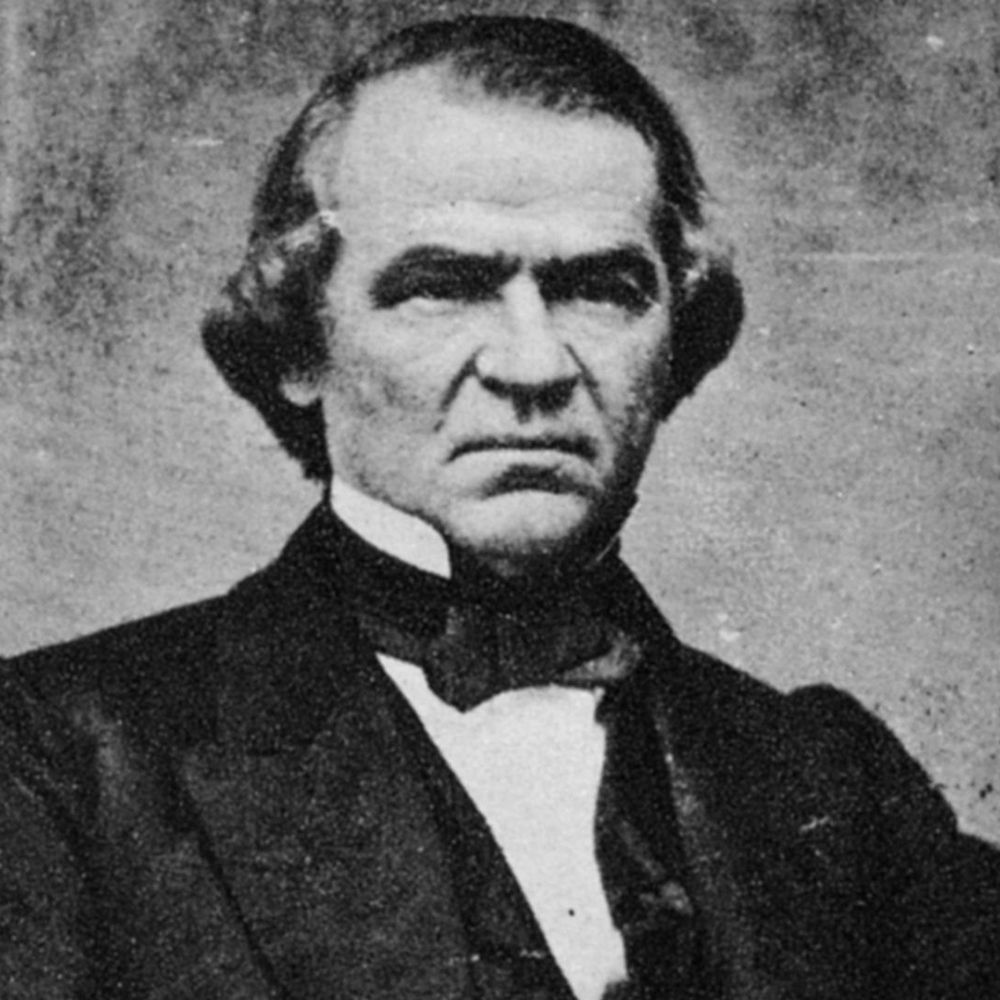
(1808-1875)
Who Was Andrew Johnson?
Andrew Johnson became the 17th president of the United States upon the assassination of President Abraham Lincoln in April 1865. His lenient Reconstruction policies toward the South, and his vetoing of Reconstruction acts, embittered the Radical Republicans in Congress and led to his political downfall and impeachment, though he was acquitted.
Early Life
Johnson was born in a log cabin in Raleigh, North Carolina, on December 29, 1808. His father, Jacob, died when Johnson was 3, leaving the family in poverty. His mother, Mary "Polly" McDonough Johnson, worked as a seamstress to make ends meet. She and her second husband apprenticed Johnson and his brother, William, to a local tailor. As a young boy, Johnson felt the sting of prejudice from the higher classes and developed a white-supremacist attitude to compensate, a perception he held all his life.
Chafing under the constraints of apprenticeship, Johnson and his brother ran away from their obligation. The pair dodged authorities who sought to return them to their employer and worked as itinerate tailors. The boys later returned home, and the family moved to Greeneville, Tennessee. In a short time, Johnson established a very successful tailoring business and married Eliza McCardle in 1827. She encouraged him in his self-education and counseled him on business investments. Eliza suffered from tuberculosis, but remained a constant supporter of Johnson through their 50-year marriage.
Foray Into Politics
Johnson took a strong interest in politics, and his tailor shop became a haven for political discussion. He gained the support of the local working class and became their strong advocate. He was elected alderman in 1829, and was elected mayor of Greeneville five years later. After the 1831 Nat Turner Rebellion, Tennessee adopted a new state constitution with a provision to disenfranchise free Black people. Johnson supported the provision and campaigned around the state for its ratification, giving him wide exposure.
In 1835, Johnson won a seat in the Tennessee state legislature. He identified himself with the Democratic policies of Andrew Jackson, advocating for the poor and being opposed to non-essential government spending. He was also a strong anti-abolitionist and a promoter of states' rights, while still being an unqualified supporter of the Union.
U.S. Congressman and Tennessee Governor
In 1843, Johnson became the first Democrat from Tennessee to be elected to the United States Congress. He joined a new Democratic majority in the House of Representatives, declaring that slavery was essential to the preservation of the Union. This was a slight departure from his fellow Southerners, who were beginning to speak of separation if slavery was abolished. During his fifth and final term in Congress, the Whig party was gaining ground in Tennessee, and Johnson saw that his chances for a sixth term were slim.
In 1853, Johnson was elected governor of Tennessee. During his two terms, he tried to promote his fiscally conservative, populist views, but found the experience frustrating, as the governor's constitutional powers were limited to giving suggestions to the legislature, with no veto power. He made the most of his position by giving important appointments to political allies.
As the 1856 election neared, Johnson briefly considered a run for the presidency, but felt he didn't have quite the national exposure he needed. He decided to instead run for a seat in the U.S. Senate. Even though his party controlled the legislature, the campaign was difficult. Many Democratic leaders disapproved of his populist views. However, the Tennessee legislature did elect him, and the reaction by the opposition press was immediate and scathing. The Richmond Whig referred to Johnson as "the vilest radical and most unscrupulous demagogue in the Union."
As senator, Johnson introduced the Homestead Act, a bill he had promoted while a congressman. The bill met with stiff opposition by many Southern Democrats, who feared the land would be settled by poor whites and immigrants who couldn't afford, or didn't want, slavery in the area. A heavily amended bill was passed, but was vetoed by President Buchanan. For the remainder of his Senate term, Johnson kept an independent course, opposing abolition while making clear his devotion to the Union.
The Lincoln Administration
After Abraham Lincoln's election in 1860, Tennessee seceded from the Union. Johnson broke with his home state and became the only Southern senator to retain his seat in the U.S. Senate. He was vilified in the South. His property was confiscated, and his wife and two daughters were driven out of Tennessee. However, his pro-Union passion did not go unnoticed by the Lincoln Administration. Once Union troops occupied Tennessee in 1862, Lincoln appointed Johnson military governor. He walked a difficult line, offering an olive branch to his fellow Tennesseans while exercising the full force of the federal government to rebels. He was never able to gain complete control of the state as insurgents, led by Confederate General Nathan Bedford Forrest, raided cities and towns at will.
Johnson originally opposed the Emancipation Proclamation, but after gaining an exemption for Tennessee and realizing that it was an important tool for ending the war, he accepted it. Southern papers caught his flip-flopping and accused him of seeking a higher office. This notion played out when Lincoln, concerned about his chances for reelection, tapped Johnson as his vice president to help balance the ticket in 1864. After several high-profile Union victories in the summer and fall of 1864, Lincoln was re-elected in a sweeping victory.
Presidency and Impeachment
On the night of April 14, 1865, while spending an evening at Ford's Theater, in Washington, D.C., President Lincoln was shot by John Wilkes Booth, and he died the next morning. Johnson was also a target on that fateful night, but his would-be assassin failed to show up. Three hours after Lincoln died, Johnson was sworn in as the 17th president of the United States. In a strange irony often found in American history, the racist Southerner Johnson was charged with the reconstruction of the South and the extension of civil rights and suffrage to former Black slaves. It quickly became apparent that Johnson would not force Southern states to grant full equality to Black people, thus setting up a confrontation with congressional Republicans who sought Black suffrage as essential to furthering their political influence in the South.
Congress was in recess the first eight months of Johnson's term, and he took full advantage of the legislators' absence by pushing through his own Reconstruction policies. He quickly issued pardons and amnesty to any rebels who would take an oath of allegiance. This resulted in many former Confederates being elected to office in Southern states and instituting "Black codes," which essentially maintained slavery. Later, he expanded his pardons to include Confederate officials of the highest rank, including Alexander Stephens, who had served as vice president under Jefferson Davis.
When Congress reconvened, members expressed outrage at the president's clemency orders and his lack of protecting Black civil rights. In 1866, Congress passed the Freedmen's Bureau bill, providing essentials for former slaves and protection of their rights in court. They then passed the Civil Rights Act, defining "all persons born in the United States and not subject to any foreign power, excluding Indians not taxed," as citizens. Johnson vetoed these two measures because he felt that Southern states were not represented in Congress and believed that setting suffrage policy was the responsibility of the states, not the federal government. Both vetoes were overridden by Congress.
That June, Congress approved the 14th Amendment and issued it to the states for ratification, and it was accepted less than one month later. In a novel interpretation of the "advise and consent" clause of the Constitution, Congress also passed the Tenure of Office Act, which denied the president the power to remove federal officials without the Senate's approval. In 1867, Congress established military Reconstruction in the former Confederate states to enforce political and social rights for Southern Black people.
President Johnson retaliated by appealing directly to the people in a series of speeches during the 1866 congressional elections. On more than one occasion, it appeared that Johnson had had too much to drink, and antagonized more than convinced his audiences. The campaign was a complete disaster, and Johnson faced a further loss of support from the public. The Radical Republicans won an overwhelming victory in the midterm elections.
Johnson felt his position as president crumbling beneath him. He had lost the support of Congress and the public, and felt that his only alternative was to challenge the Tenure of Office Act as a direct violation of his constitutional authority. In August 1867, he fired Secretary of War Edwin Stanton, with whom he'd had several confrontations. In February 1868, the House voted to impeach President Johnson for violation of the Tenure of Office Act, and for bringing disgrace and ridicule on Congress. He was tried in the Senate and acquitted by one vote. He remained president, but both his credibility and effectiveness were destroyed.
Later Years and Legacy
Johnson finished his term maintaining his opposition to Reconstruction and continuing his self-imposed role as protector of the white race. After leaving the White House, he took advantage of his excellent oratory skills and went on the speaking circuit. In 1874, he won election to the U.S. Senate for a second time. In his first speech after returning to the Senate, he spoke out in opposition to President Ulysses S. Grant's military intervention in Louisiana. During the Congressional recess the following summer, Johnson died from a stroke near Elizabethton, Tennessee, on July 31, 1875. According to his wishes, he was buried just outside Greeneville, his body wrapped in an American flag and a copy of the Constitution placed under his head.
Some historians view Johnson as the worst person who could have been president at the end of the Civil War. His racist views prevented him from making a satisfying peace. His lack of political skills alienated him from Congress, and his arrogance lost him the public's support. As president, he probably contributed to the national strife that followed the Civil War, and lost the opportunity to champion the rights of the disadvantaged.
QUICK FACTS
- Name: Andrew Johnson
- Birth Year: 1808
- Birth date: December 29, 1808
- Birth State: North Carolina
- Birth City: Raleigh
- Birth Country: United States
- Gender: Male
- Best Known For: Andrew Johnson succeeded Abraham Lincoln as president and was the first president of the United States to be impeached.
- Industries
- U.S. Politics
- Astrological Sign: Capricorn
- Death Year: 1875
- Death date: July 31, 1875
- Death State: Tennessee
- Death City: Elizabethton
- Death Country: United States
Fact Check
We strive for accuracy and fairness.If you see something that doesn't look right,contact us!
CITATION INFORMATION
- Article Title: Andrew Johnson Biography
- Author: Biography.com Editors
- Website Name: The Biography.com website
- Url: https://www.biography.com/political-figures/andrew-johnson
- Access Date:
- Publisher: A&E; Television Networks
- Last Updated: April 22, 2021
- Original Published Date: April 2, 2014
QUOTES
- I feel incompetent to perform duties ... which have been so unexpectedly thrown upon me.
- The goal to strive for is a poor government but a rich people.
- It's a damn poor mind that can only think of one way to spell a word.
- There are no good laws but such as repeal other laws.


