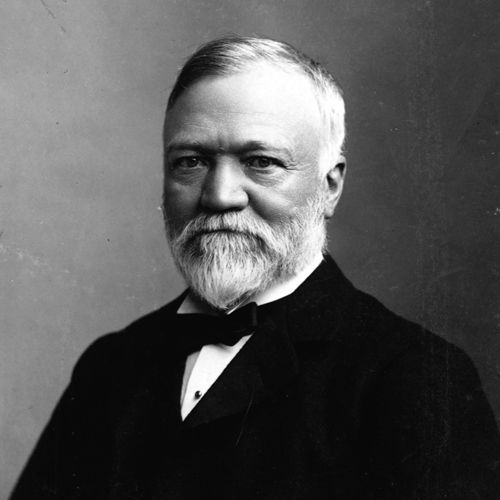
(1835-1919)
Who Was Andrew Carnegie?
After moving to the United States from Scotland, Andrew Carnegie worked a series of railroad jobs. By 1889, he owned Carnegie Steel Corporation, the largest of its kind in the world. In 1901 he sold his business and dedicated his time to expanding his philanthropic work, including the establishment of Carnegie-Mellon University in 1904.
Early Life
Andrew Carnegie was born on November 25, 1835, in Dunfermline, Fife, Scotland. Although he had little formal education, Carnegie grew up in a family that believed in the importance of books and learning. The son of a handloom weaver, Carnegie grew up to become one of the wealthiest businessmen in America.
At the age of 13, in 1848, Carnegie came to the United States with his family. They settled in Allegheny, Pennsylvania, and Carnegie went to work in a factory, earning $1.20 a week. The next year he found a job as a telegraph messenger. Hoping to advance his career, he moved up to a telegraph operator position in 1851. He then took a job at the Pennsylvania Railroad in 1853. He worked as the assistant and telegrapher to Thomas Scott, one of the railroad's top officials. Through this experience, he learned about the railroad industry and about business in general. Three years later, Carnegie was promoted to superintendent.
Steel Tycoon
While working for the railroad, Carnegie began making investments. He made many wise choices and found that his investments, especially those in oil, brought in substantial returns. He left the railroad in 1865 to focus on his other business interests, including the Keystone Bridge Company.
By the next decade, most of Carnegie's time was dedicated to the steel industry. His business, which became known as the Carnegie Steel Company, revolutionized steel production in the United States. Carnegie built plants around the country, using technology and methods that made manufacturing steel easier, faster and more productive. For every step of the process, he owned exactly what he needed: the raw materials, ships and railroads for transporting the goods, and even coal fields to fuel the steel furnaces.
This start-to-finish strategy helped Carnegie become the dominant force in the industry and an exceedingly wealthy man. It also made him known as one of America's "builders," as his business helped to fuel the economy and shape the nation into what it is today. By 1889, Carnegie Steel Corporation was the largest of its kind in the world.
Some felt that the company's success came at the expense of its workers. The most notable case of this came in 1892. When the company tried to lower wages at a Carnegie Steel plant in Homestead, Pennsylvania, the employees objected. They refused to work, starting what has been called the Homestead Strike of 1892. The conflict between the workers and local managers turned violent after the managers called in guards to break up the union. While Carnegie was away at the time of strike, many still held him accountable for his managers' actions.
Philanthropy
In 1901, Carnegie made a dramatic change in his life. He sold his business to the United States Steel Corporation, started by legendary financier J.P. Morgan. The sale earned him more than $200 million. At the age of 65, Carnegie decided to spend the rest of his days helping others. While he had begun his philanthropic work years earlier by building libraries and making donations, Carnegie expanded his efforts in the early 20th century.
Carnegie, an avid reader for much of his life, donated approximately $5 million to the New York Public Library so that the library could open several branches in 1901. Devoted to learning, he established the Carnegie Institute of Technology in Pittsburgh, which is now known as Carnegie-Mellon University in 1904. The next year, he created the Carnegie Foundation for the Advancement of Teaching in 1905. With his strong interest to peace, he formed the Carnegie Endowment for International Peace in 1910. He made numerous other donations, and it is said that more than 2,800 libraries were opened with his support.
Besides his business and charitable interests, Carnegie enjoyed traveling and meeting and entertaining leading figures in many fields. He was friends with Matthew Arnold, Mark Twain, William Gladstone, and Theodore Roosevelt. Carnegie also wrote several books and numerous articles. His 1889 article "Wealth" outlined his view that those with great wealth must be socially responsible and use their assets to help others. This was later published as the 1900 book The Gospel of Wealth.
Death
Carnegie died on August 11, 1919, in Lenox, Massachusetts, at the age of 83.
QUICK FACTS
- Name: Andrew Carnegie
- Birth Year: 1835
- Birth date: November 25, 1835
- Birth City: Dunfermline, Scotland
- Birth Country: United Kingdom
- Gender: Male
- Best Known For: Andrew Carnegie was a self-made steel tycoon and one of the wealthiest businessmen of the 19th century. He later dedicated his life to philanthropic endeavors.
- Industries
- Business and Industry
- Astrological Sign: Sagittarius
- Death Year: 1919
- Death date: August 11, 1919
- Death State: Massachusetts
- Death City: Lenox
- Death Country: United States
Fact Check
We strive for accuracy and fairness.If you see something that doesn't look right,contact us!
CITATION INFORMATION
- Article Title: Andrew Carnegie Biography
- Author: Biography.com Editors
- Website Name: The Biography.com website
- Url: https://www.biography.com/business-leaders/andrew-carnegie
- Access Date:
- Publisher: A&E; Television Networks
- Last Updated: May 26, 2021
- Original Published Date: April 3, 2014
QUOTES
- People who are unable to motivate themselves must be content with mediocrity, no matter how impressive their other talents.
- The man who dies thus rich dies disgraced.
- I cannot tell you how proud I was when I received my first week's own earnings. One dollar and twenty cents made by myself and given to me because I had been of some use in the world!
- I always liked the idea of being my own master, of manufacturing something and giving employment to many men.
- In bestowing charity, the main consideration should be to help those who will help themselves.
- I should as soon leave to my son a curse as the almighty dollar.
- No party is so foolish as to nominate for the presidency a rich man, much less a millionaire. Democracy elects poor men.
- There is always room at the top in every pursuit. Concentrate all your thought and energy upon the performance of your duties. Put all your eggs into one basket and then watch that basket.
- Do not make riches, but usefulness, your first aim.
- I congratulate poor young men upon being born to that ancient and honorable degree which renders it necessary that they should devote themselves to hard work.
- The aim of the millionaire should be, first, to set an example of modest, unostentatious living, shunning display and extravagances.