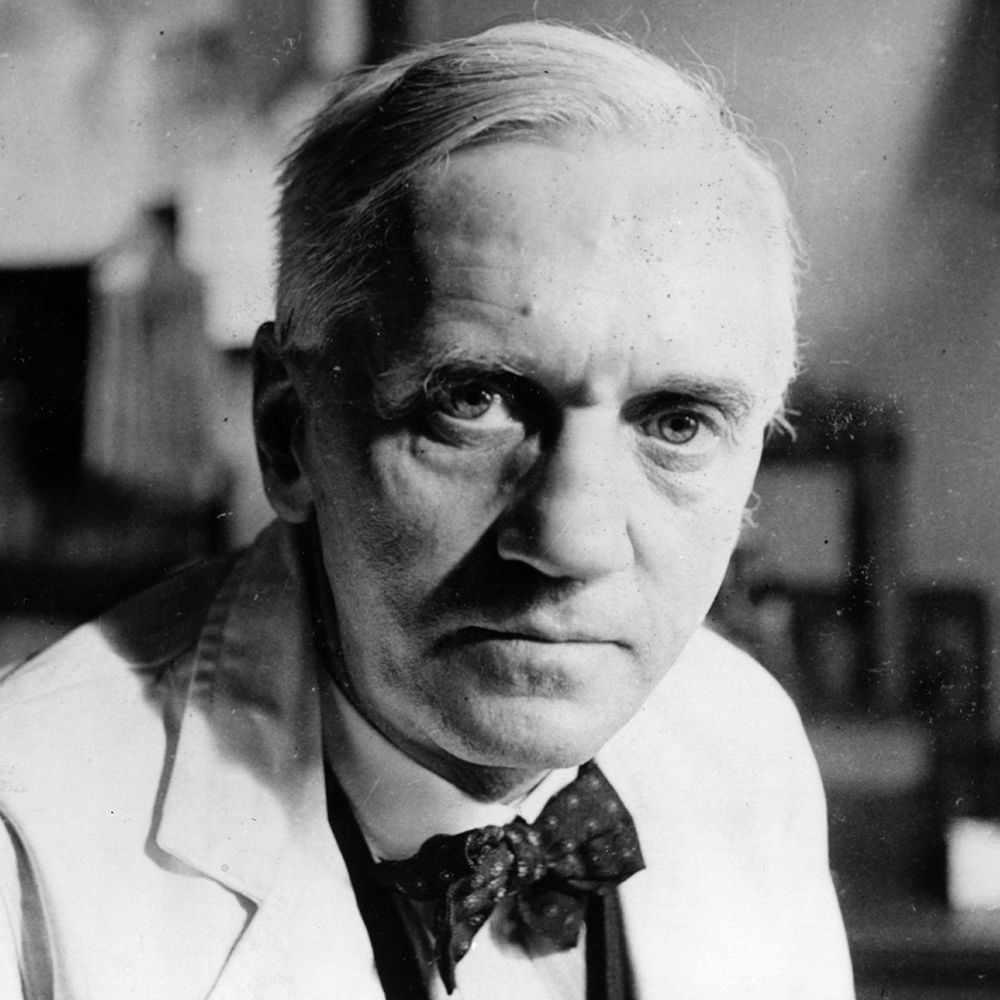
(1881-1955)
Who Was Alexander Fleming?
Alexander Fleming was born in Ayrshire, Scotland, on August 6, 1881, and studied medicine, serving as a physician during World War I. Through research and experimentation, Fleming discovered a bacteria-destroying mold which he would call penicillin in 1928, paving the way for the use of antibiotics in modern healthcare. He was awarded the Nobel Prize in 1945 and died on March 11, 1955.
Early Years
Alexander Fleming was born in rural Lochfield, in East Ayrshire, Scotland, on August 6, 1881. His parents, Hugh and Grace were farmers, and Alexander was one of their four children. He also had four half-siblings who were the surviving children from his father Hugh's first marriage. He attended the Louden Moor School, the Darvel School and Kilmarnock Academy before moving to London in 1895, where he lived with his older brother, Thomas Fleming. In London, Fleming finished his basic education at the Regent Street Polytechnic (now the University of Westminster).
Fleming was a member of the Territorial Army and served from 1900 to 1914 in the London Scottish Regiment. He entered the medical field in 1901, studying at St. Mary's Hospital Medical School at the University of London. While at St. Mary's, he won the 1908 gold medal as the top medical student.
Early Career and World War I
Fleming had planned on becoming a surgeon, but a temporary position in the Inoculation Department at St. Mary's Hospital changed his path toward the then-new field of bacteriology. There, he developed his research skills under the guidance of bacteriologist and immunologist Sir Almroth Edward Wright, whose revolutionary ideas of vaccine therapy represented an entirely new direction in medical treatment.
During World War I, Fleming served in the Royal Army Medical Corps. He worked as a bacteriologist, studying wound infections in a makeshift lab that had been set up by Wright in Boulogne, France. Through his research there, Fleming discovered that antiseptics commonly used at the time were doing more harm than good, as their diminishing effects on the body's immunity agents largely outweighed their ability to break down harmful bacteria — therefore, more soldiers were dying from antiseptic treatment than from the infections they were trying to destroy. Fleming recommended that, for more effective healing, wounds simply be kept dry and clean. However, his recommendations largely went unheeded.
Returning to St. Mary's after the war, in 1918, Fleming took on a new position: assistant director of St. Mary's Inoculation Department. (He would become a professor of bacteriology at the University of London in 1928, and an emeritus professor of bacteriology in 1948.)
In November 1921, while nursing a cold, Fleming discovered lysozyme, a mildly antiseptic enzyme present in body fluids, when a drop of mucus dripped from his nose onto a culture of bacteria. Thinking that his mucus might have some kind of effect on bacterial growth, he mixed it with the culture. A few weeks later, he observed that the bacteria had been dissolved. This marked Fleming's first great discovery, as well as a significant contribution to human immune system research. (As it turned out, however, lysozyme had no effect on the most destructive bacteria.)
The Road to Penicillin
In September 1928, Fleming returned to his laboratory after a month away with his family, and noticed that a culture of Staphylococcus aureus he had left out had become contaminated with a mold (later identified as Penicillium notatum). He also discovered that the colonies of staphylococci surrounding this mold had been destroyed.
He later said of the incident, "When I woke up just after dawn on September 28, 1928, I certainly didn't plan to revolutionize all medicine by discovering the world's first antibiotic, or bacteria killer. But I suppose that was exactly what I did." He at first called the substance "mold juice," and then named it "penicillin," after the mold that produced it.
Thinking he had found an enzyme more powerful than lysozyme, Fleming decided to investigate further. What he found out, though, was that it was not an enzyme at all, but an antibiotic -- one of the first antibiotics to be discovered. Further development of the substance was not a one-man operation, as his previous efforts had been, so Fleming recruited two young researchers. The three men unfortunately failed to stabilize and purify penicillin, but Fleming pointed out that penicillin had clinical potential, both in topical and injectable forms, if it could be developed properly.
On the heels of Fleming's discovery, a team of scientists from the University of Oxford — led by Howard Florey and his co-worker, Ernst Chain — isolated and purified penicillin. The antibiotic eventually came into use during World War II, revolutionizing battlefield medicine and, on a much broader scale, the field of infection control.
Florey, Chain and Fleming shared the 1945 Nobel Prize in Physiology or Medicine, but their relationship was tainted over who should receive the most credit for penicillin. The press tended to emphasize Fleming's role due to the compelling back-story of his chance discovery and his greater willingness to be interviewed.
Later Years and Honors
In 1946, Fleming succeeded Almroth Edward Wright as head of St. Mary's Inoculation Department, which was renamed the Wright-Fleming Institute. Additionally, Fleming served as president of the Society for General Microbiology, a member of the Pontifical Academy of Science, and an honorary member of nearly every medical and scientific society in the world.
Outside of the scientific community, Fleming was named rector of Edinburgh University from 1951 to 1954, freeman of many municipalities, and Honorary Chief Doy-gei-tau of the American Indian Kiowa tribe. He was also awarded honorary doctorate degrees from nearly 30 European and American universities.
Fleming died of a heart attack on March 11, 1955, at his home in London, England. He was survived by his second wife, Dr. Amalia Koutsouri-Vourekas, and his only child, Robert, from his first marriage.
QUICK FACTS
- Name: Alexander Fleming
- Birth Year: 1881
- Birth date: August 6, 1881
- Birth City: Lochfield Farm, Darvel, Ayrshire
- Birth Country: Scotland
- Gender: Male
- Best Known For: Alexander Fleming was a doctor and bacteriologist who discovered penicillin, receiving the Nobel Prize in 1945.
- Industries
- World War I
- Education and Academia
- Science and Medicine
- Astrological Sign: Leo
- Schools
- Darvel School
- Regent Street Polytechnic (now the University of Westminster)
- Louden Moor School
- University of London, St. Mary's Hospital Medical School
- Kilmarnock Academy
- Nacionalities
- Scot (Scotland)
- Death Year: 1955
- Death date: March 11, 1955
- Death City: London, England
- Death Country: United Kingdom
Fact Check
We strive for accuracy and fairness.If you see something that doesn't look right,contact us!
CITATION INFORMATION
- Article Title: Alexander Fleming Biography
- Author: Biography.com Editors
- Website Name: The Biography.com website
- Url: https://www.biography.com/scientists/alexander-fleming
- Access Date:
- Publisher: A&E; Television Networks
- Last Updated: May 27, 2021
- Original Published Date: April 2, 2014
QUOTES
- I certainly didn't plan to revolutionize all medicine by discovering the world's first antibiotic, or bacteria killer. But I suppose that was exactly what I did.
- One sometimes finds what one is not looking for.