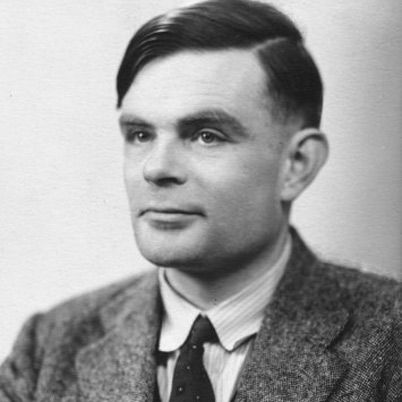
(1912-1954)
Who Was Alan Turing?
Alan Turing was a brilliant British mathematician who took a leading role in breaking Nazi ciphers during WWII. In his seminal 1936 paper, he proved that there cannot exist any universal algorithmic method of determining truth in mathematics, and that mathematics will always contain undecidable propositions. His work is widely acknowledged as foundational research of computer science and artificial intelligence.
Early Life
English scientist Alan Turing was born Alan Mathison Turing on June 23, 1912, in Maida Vale, London, England. At a young age, he displayed signs of high intelligence, which some of his teachers recognized, but did not necessarily respect. When Turing attended the well-known independent Sherborne School at the age of 13, he became particularly interested in math and science.
After Sherborne, Turing enrolled at King's College (University of Cambridge) in Cambridge, England, studying there from 1931 to 1934. As a result of his dissertation, in which he proved the central limit theorem, Turing was elected a fellow at the school upon his graduation.
In 1936, Turing delivered a paper, "On Computable Numbers, with an Application to the Entscheidungsproblem," in which he presented the notion of a universal machine (later called the “Universal Turing Machine," and then the "Turing machine") capable of computing anything that is computable: It is considered the precursor to the modern computer.
Over the next two years, Turing studied mathematics and cryptology at the Institute for Advanced Study in Princeton, New Jersey. After receiving his Ph.D. from Princeton University in 1938, he returned to Cambridge, and then took a part-time position with the Government Code and Cypher School, a British code-breaking organization.
Cryptanalysis and Early Computers
During World War II, Turing was a leading participant in wartime code-breaking, particularly that of German ciphers. He worked at Bletchley Park, the GCCS wartime station, where he made five major advances in the field of cryptanalysis, including specifying the bombe, an electromechanical device used to help decipher German Enigma encrypted signals.
Turing’s contributions to the code-breaking process didn’t stop there: He also wrote two papers about mathematical approaches to code-breaking, which became such important assets to the Code and Cypher School (later known as the Government Communications Headquarters) that the GCHQ waited until April 2012 to release them to the National Archives of the United Kingdom.
Turing moved to London in the mid-1940s, and began working for the National Physical Laboratory. Among his most notable contributions while working at the facility, Turing led the design work for the Automatic Computing Engine and ultimately created a groundbreaking blueprint for store-program computers. Though a complete version of the ACE was never built, its concept has been used as a model by tech corporations worldwide for several years, influencing the design of the English Electric DEUCE and the American Bendix G-15 — credited by many in the tech industry as the world’s first personal computer — among other computer models.
Turing went on to hold high-ranking positions in the mathematics department and later the computing laboratory at the University of Manchester in the late 1940s. He first addressed the issue of artificial intelligence in his 1950 paper, "Computing machinery and intelligence," and proposed an experiment known as the “Turing Test” — an effort to create an intelligence design standard for the tech industry. Over the past several decades, the test has significantly influenced debates over artificial intelligence.
Homosexuality, Conviction and Death
Homosexuality was illegal in the United Kingdom in the early 1950s, so when Turing admitted to police, called to his house after a January 1952 break-in, that he'd had a sexual relationship with the perpetrator, 19-year-old Arnold Murray, he was charged with gross indecency. Following his arrest, Turing was forced to choose between temporary probation on the condition that he receive hormonal treatment for libido reduction, or imprisonment. He chose the former, and soon underwent chemical castration through injections of a synthetic estrogen hormone for a year, which eventually rendered him impotent.
As a result of his conviction, Turing's security clearance was removed and he was barred from continuing his work with cryptography at the GCCS, which had become the GCHQ in 1946.
Turing died on June 7, 1954. Following a postmortem exam, it was determined that the cause of death was cyanide poisoning. The remains of an apple were found next to the body, though no apple parts were found in his stomach. The autopsy reported that "four ounces of fluid which smelled strongly of bitter almonds, as does a solution of cyanide" was found in the stomach. Trace smell of bitter almonds was also reported in vital organs. The autopsy concluded that the cause of death was asphyxia due to cyanide poisoning and ruled a suicide.
In a June 2012 BBC article, philosophy professor and Turing expert Jack Copeland argued that Turing's death may have been an accident: The apple was never tested for cyanide, nothing in the accounts of Turing's last days suggested he was suicidal and Turing had cyanide in his house for chemical experiments he conducted in his spare room.
Awards, Recognition and Royal Pardon
Shortly after World War II, Turing was awarded an Order of the British Empire for his work. For what would have been his 86th birthday, Turing biographer Andrew Hodges unveiled an official English Heritage blue plaque at his childhood home.
In June 2007, a life-size statue of Turing was unveiled at Bletchley Park, in Buckinghamshire, England. A bronze statue of Turing was unveiled at the University of Surrey on October 28, 2004, to mark the 50th anniversary of his death. Additionally, the Princeton University Alumni Weekly named Turing the second most significant alumnus in the history of the school — James Madison held the No. 1 position.
Turing was honored in a number of other ways, particularly in the city of Manchester, where he worked toward the end of his life. In 1999, Time magazine named him one of its "100 Most Important People of the 20th century," saying, "The fact remains that everyone who taps at a keyboard, opening a spreadsheet or a word-processing program, is working on an incarnation of a Turing machine." Turing was also ranked 21st on the BBC nationwide poll of the "100 Greatest Britons" in 2002. By and large, Turing has been recognized for his impact on computer science, with many crediting him as the "founder" of the field.
Following a petition started by John Graham-Cumming, then-Prime Minister Gordon Brown released a statement on September 10, 2009, on behalf of the British government, which posthumously apologized to Turing for prosecuting him as a homosexual.
"This recognition of Alan's status as one of Britain's most famous victims of homophobia is another step towards equality and long overdue. But even more than that, Alan deserves recognition for his contribution to humankind," Brown stated. "It is thanks to men and women who were totally committed to fighting fascism, people like Alan Turing, that the horrors of the Holocaust and of total war are part of Europe's history and not Europe's present. So on behalf of the British government, and all those who live freely thanks to Alan's work I am very proud to say: we're sorry, you deserved so much better."
In 2013, Queen Elizabeth II posthumously granted Turing a rare royal pardon almost 60 years after he committed suicide. Three years later, on October 20, 2016, the British government announced “Turing’s Law” to posthumously pardon thousands of gay and bisexual men who were convicted for homosexual acts when it was considered a crime. According to a statement issued by Justice Minister Sam Gyimah, the law also automatically pardons living people who were “convicted of historical sexual offenses who would be innocent of any crime today.
In July 2019, the Bank of England announced that Turing would appear on the UK's new £50 note, along with images of his work. The famed scientist was chosen from a list of nearly 1,000 candidates nominated by the general public, including theoretical physicist Stephen Hawking and mathematician Ada Lovelace.
QUICK FACTS
- Name: Alan Turing
- Birth Year: 1912
- Birth date: June 23, 1912
- Birth City: London
- Birth Country: United Kingdom
- Gender: Male
- Best Known For: The famed code-breaking war hero, now considered the father of computer science and artificial intelligence, was criminally convicted and harshly treated under the U.K.'s homophobic laws.
- Astrological Sign: Cancer
- Schools
- Sherborne School
- Princeton University
- Princeton Institute for Advanced Study
- St. Michael's School
- King's College (University of Cambridge)
- Death Year: 1954
- Death date: June 7, 1954
- Death City: Wilmslow
- Death Country: United Kingdom
Fact Check
We strive for accuracy and fairness.If you see something that doesn't look right,contact us!
CITATION INFORMATION
- Article Title: Alan Turing Biography
- Author: Biography.com Editors
- Website Name: The Biography.com website
- Url: https://www.biography.com/scientists/alan-turing
- Access Date:
- Publisher: A&E; Television Networks
- Last Updated: July 22, 2020
- Original Published Date: April 2, 2014
QUOTES
- We can only see a short distance ahead, but we can see plenty there that needs to be done.
- I believe that at the end of the century the use of words and general educated opinion will have altered so much that one will be able to speak of machines thinking without expecting to be contradicted.
- Science is a differential equation. Religion is a boundary condition.
- A computer would deserve to be called intelligent if it could deceive a human into believing that it was human.